

Touring Multigenerational Homes
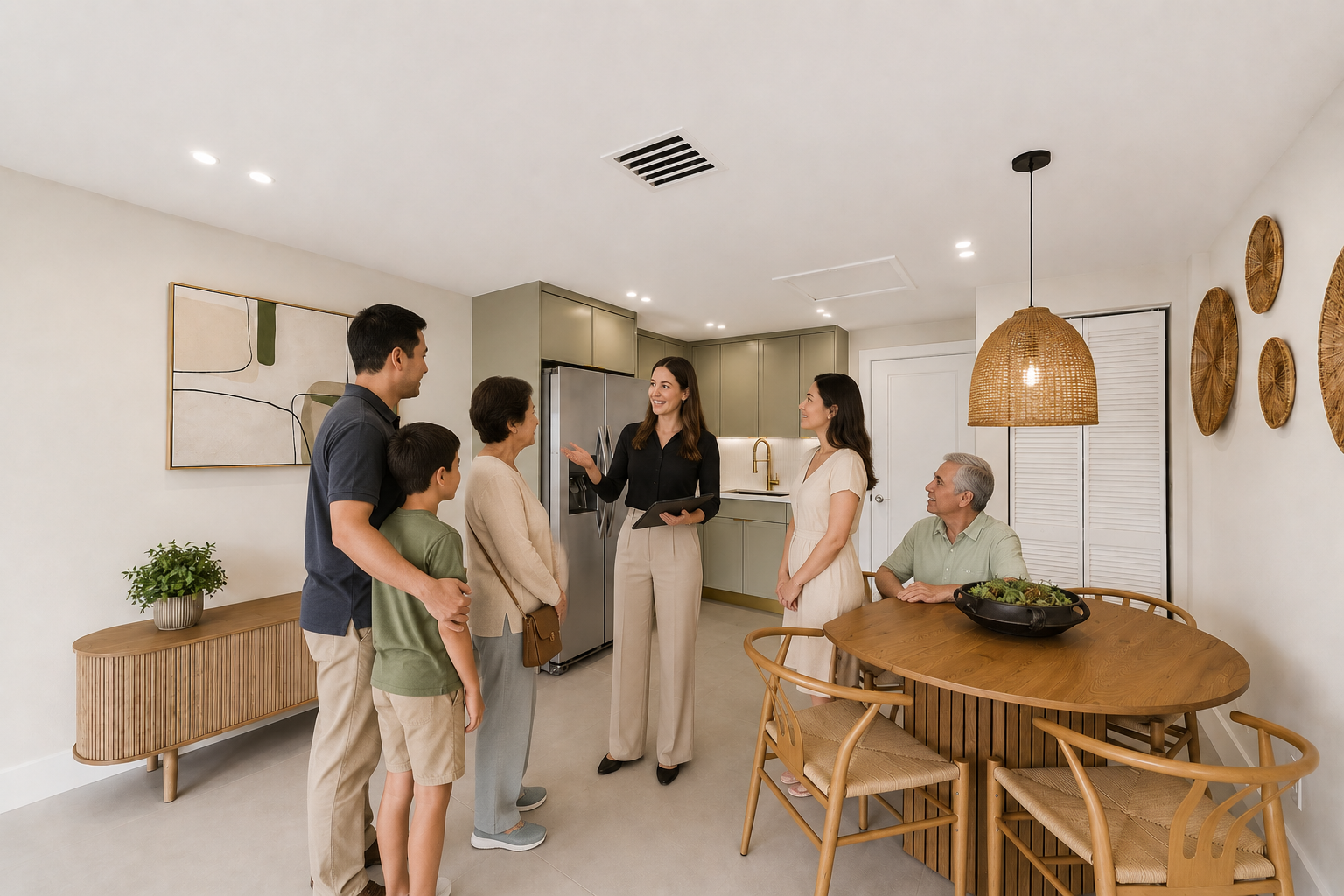
Stage 04 — Touring
Touring Multi-Generational Homes
Touring a home that might be a multi-generational fit is different from touring a standard residence. There are specific things to evaluate, specific questions to ask, and specific signals — both promising and warning — that experienced multi-generational buyers learn to read.
This page is the practical guide we’d hand a family before any showing. Save it, screenshot it, take it with you. Whether you’re walking through a home with a true mother-in-law suite, a detached casita, a finished ADU, or a converted in-law apartment, these are the things that matter.
A home that looks right in photos doesn’t always work in person. A home that looks ordinary in photos sometimes turns out to be exactly what your family needs. The tour is where you find out.
Before the tour
What to Review Before You Walk Through the Door
A surprising amount of evaluation can happen before you ever set foot on the property. Most multi-generational buyers waste time touring homes that obviously don’t qualify because no one looked carefully at the listing first.
Look at the floorplan if one is available. Trace the route from the suite or guest house to its bathroom, kitchenette, and entrance. Trace the same route from the main home’s primary bedroom to its kitchen and living spaces. If those routes overlap heavily — if both households have to cross the same hallway to get to their daily essentials — the layout isn’t going to support two independent lives, regardless of how it looks in photos.
Look at the photos with intention. Where are the doors? Where are the windows? Does the suite have a window that opens onto the main home’s primary outdoor space? Is there a visible second entrance? Does the kitchenette area in the photos actually look like a kitchen, or like someone staged a microwave on a dresser? These questions tell you whether the property is worth the drive.
During the tour
Twelve Things to Evaluate at Every Showing
Walk through these in order. Some take seconds to evaluate. Others require slowing down and looking carefully. All of them matter.
Item 01
The Entrance to the Suite
Is there a private or semi-private entrance to the in-law suite, casita, or guest house? Where does it lead — a side yard, a courtyard, a shared driveway, or directly through the main home? An entrance that requires walking through the primary household’s living area isn’t a true separate entrance — it’s a hallway with a door at the end.
Item 02
Acoustic Separation
Stand inside the suite and have your agent or a family member talk at normal volume in the main living area. Can you hear them clearly? Slightly muffled? Not at all? This single test tells you more about daily livability than any other detail. Walls that share with TV rooms, kitchens, or staircases will carry sound. Walls that share with closets, hallways, or other bedrooms will not.
Item 03
Bathroom Placement and Accessibility
Is the suite’s bathroom directly accessible from inside the suite, or do you have to leave the suite to reach it? Is the doorway wide enough for a walker or wheelchair if accessibility becomes important later? Is the shower a step-in or a walk-in? For an aging parent, these details determine whether the home will work in five or ten years — not just today.
Item 04
Kitchenette or Kitchen
If there’s a kitchenette, is it functional — refrigerator, sink, cooking surface, prep counter — or is it a microwave on a console? If there’s no kitchenette, is plumbing roughed in nearby? Look for a sink in the bathroom that shares a wall with potential kitchenette space. The difference between adding a kitchenette where plumbing exists ($5,000–$15,000) and where it doesn’t ($20,000–$50,000+) is meaningful.
Item 05
Daily Traffic Flow
Walk the route both households would take in a typical morning. Suite-dweller wakes up, uses the bathroom, makes coffee. Main household does the same. Do those routes cross? Do you bump into each other in a shared hallway? In a great multi-generational layout, both households can complete their morning routine without overlapping until they choose to.
Item 06
Visual Privacy and Sightlines
Look out every window in the suite. What do you see? The neighbor’s driveway is fine. The main home’s pool deck where the family hosts barbecues might not be. The front yard with cars coming and going is generally fine. The main home’s master bedroom window, ten feet across a courtyard, isn’t great. Privacy is built from sightlines, not just walls.
Item 07
Laundry Access
Where is the laundry? Inside the suite, separately accessible to the suite, or only inside the main home? For an independent older parent or adult child, walking through the main household every time you do laundry is a small daily friction that adds up. A separate stackable in the suite, or even just a hookup that allows for one, transforms daily life.
Item 08
Parking and Vehicle Access
Where do guests park if they’re visiting the suite? Where do guests park if they’re visiting the main home? Do those parking situations create awkwardness — a friend visiting the parent has to walk past the kids’ soccer practice in the driveway? For aging parents who may have caregivers, home health visits, or grandchildren picking up grandma for outings, parking flow matters more than people expect.
Item 09
Outdoor Space
Does the suite have its own patio, courtyard, or porch? Or is the only outdoor space the main home’s backyard, where the suite-dweller is essentially a guest? In Florida, where outdoor living is part of daily life, a suite without its own outdoor area can feel claustrophobic. A small private patio for the in-law suite or a separate courtyard for the casita is often the difference between independence and isolation.
Item 10
Climate Control
Is the suite on a separate HVAC zone, its own mini-split, or sharing the main home’s thermostat? In Florida, where some households want it 68 degrees and others 76, this matters more than in cooler climates. A separate mini-split or zone in the in-law suite or accessory dwelling unit is one of the most desirable features and one of the most expensive to retrofit.
Item 11
Storage
Closets in the suite, attic or garage storage allocated to the suite-dweller, space for a parent’s heirloom furniture or an adult child’s belongings. People moving into a multi-generational home are often downsizing — but they’re not eliminating their possessions. A suite without meaningful storage forces them to either lose meaningful items or clutter their living space.
Item 12
The “Five Years From Now” Test
Stand in the suite and picture the day-to-day five years out. Is the parent who’s healthy now still healthy then? If they need a walker or a wheelchair, does this layout still work? If the adult child who’s saving for a down payment now is married with a baby then, is there room for a partner and a crib? A great home for today might be a frustrating home for tomorrow.
A home that hits ten of these well is unusual. A home that hits all twelve is rare. Don’t let the search for a perfect property stop you from recognizing a great one — but know what you’re trading off when you compromise.
Red flags
What to Watch For — Warning Signs at Showings
Some properties present beautifully but have problems that aren’t obvious until you’ve been in real estate for a while. These are the patterns we watch for that families on their own often miss.
Signs of unpermitted conversion. A garage that’s been finished as a suite — but the floor is barely above the driveway level. A kitchenette where the electrical panel doesn’t reflect the added load. A second entrance that was clearly cut into a structural wall. Florida code violations on unpermitted multi-generational additions can cost tens of thousands to remediate, or in worst cases, force you to undo the work entirely. We always check permits.
Signs of recent down-conversion. A suite where the kitchenette has clearly been removed and a closet built in its place. A separate entrance that’s been drywalled over from the inside. A space that’s been converted away from being multi-generational because the listing agent thought it would appraise better. Sometimes you can convert it back — sometimes it’s been permanently changed.
HOA restrictions on multi-generational use. Some Florida HOAs have rules about secondary kitchens, separate entrances, or accessory dwelling units that aren’t disclosed in the listing. We check the governing documents before showing properties when HOA restrictions could matter.
Stage 05 covers what to flag during the inspection and appraisal phase. Some red flags found at showings become deal-breakers in inspections. Others become negotiating leverage.
For out-of-state buyers
When You’re Touring From Out of State
A meaningful number of multi-generational buyers are relocating to Florida from other states — adult children moving parents closer, retirees joining family already here, families coordinating a move from up north. For these buyers, in-person touring time is limited and expensive. We’ve built our process around making that time count.
Pre-screening before you fly down. Before you book a trip, we evaluate properties for you against your specific criteria. We walk through homes ourselves when possible, send detailed video walkthroughs of the suite or guest house, photograph the things that matter — entrances, traffic flow, sightlines, accessibility — and tell you honestly which homes are worth your in-person time and which aren’t.
Video calls and virtual showings. When a property is worth a closer look, we do live video walk-throughs with you on the phone or via video call. You see what we see in real time. You can ask us to point the camera at specific details — the kitchenette plumbing, the entrance, the bathroom doorway width, the laundry hookup. It’s the closest thing to being there yourself.
Coordinated tour days. When you do come down, we’ve already eliminated the homes that don’t qualify. Your tour days are spent on properties we’ve validated, with backup options ready if something falls through. Out-of-state buyers we work with typically see four to six pre-qualified homes per day rather than a dozen properties that won’t work.
For families coordinating an out-of-state move, this prescreening work matters more than almost anything else we do. It’s how a single trip becomes enough.
After the tour
Debriefing What You Saw
Right after a showing, while everything is fresh, both households should debrief separately and then together. The suite-dweller’s perspective on whether they could live there is different from the main household’s perspective on whether the layout works. Both matter.
Three questions worth asking after every tour: Could you picture your daily life here? What’s the biggest compromise this home requires? What would have to change for this to be a yes?
If both households can answer those questions and feel aligned, you’ve found a real candidate. If you can’t, the next showing might be the one.
When you find the right home
From Tour to Offer to Inspection
When the right home appears, things move quickly. Multi-generational buyers tend to know it when they see it — the layout works, the configuration is right, both households agree. From there, the next stages are offer and contract, then inspection and appraisal.
Stage 05 covers the inspection and appraisal process — including the multi-generational-specific things we flag that standard inspections often miss.
Two Residences. One Address. Reach out when you’re ready to start touring.