

Does a Mother-in-Law Suite Add Value to Your Home?
Quick answer: Yes — a mother-in-law suite adds value to a Florida home, but how much depends almost entirely on whether it is a true suite. A genuine suite with a private entrance, a kitchenette, a full bath, and real separation typically adds in the range of a permitted accessory dwelling unit, roughly 15% to 30% of a property value. An “ensuite bedroom” marketed as a suite but lacking its own entrance and kitchen adds little more than an extra bedroom. The feature that drives the premium is not square footage — it is independence.
Not every “mother-in-law suite” adds the same value. The difference between a real premium and almost none comes down to five things — and most listings get it wrong.
When a parent or grandparent is part of the picture, a mother-in-law suite stops being a nice-to-have and starts being the reason a family chooses one home over another. That demand is exactly why owners ask the value question — usually from one of two directions. Some are weighing whether to add a suite and want to know the money comes back. Others already have one, are thinking about selling, and want to know what it is actually worth.
The honest answer to both is the same: a suite adds real value, but the amount is conditional. A space that lets a second generation live with genuine independence commands a premium. A bedroom with an extra bathroom that gets called a suite does not.
So how much value does a mother-in-law suite add, and what separates the two? Here is what determines which one you have — and what that means for your number.
A true suite reads to the market as a second functional residence. An ensuite reads as ordinary square footage. That single distinction is the entire ballgame on value.
It depends on whether it is actually a suite
Appraisers and buyers do not pay a premium for “a bedroom with its own bathroom.” They pay for a space someone can genuinely live in — cook a meal, host a friend, come and go — without moving through the main house. A true suite reads to the market as a second functional residence. An ensuite reads as ordinary square footage.
That distinction is why our whole approach to these homes is built around one idea: separate but together. The independence is the feature. Strip the independence out and you strip out most of the premium with it.
How much value a mother-in-law suite actually adds
Because a genuine mother-in-law suite functions like an attached accessory dwelling unit, it tends to add value in the same range a permitted ADU does — and it drops off sharply as the suite loses the features that make it independent.
These are directional ranges drawn from Florida ADU appraisal patterns — not an appraisal of any specific home. What your suite is worth depends on its layout, permit status, condition, and local demand. We dig into the permit and appraiser mechanics in our guide on whether an ADU adds home value in Florida.
The five things that turn a bedroom into a value-adding suite
Each of these is a reason a buyer pays more. The more of them a space has, the closer it sits to the top of the value range — and the broader the pool of buyers competing for it.
1. Private entry
Their own way in and out. It is what separates “a guest staying with us” from “family living independently” — and buyers feel the difference instantly.
2. Private living space
Somewhere to sit, watch TV, or host a friend without entering the main house. The feature most often skipped — and the one that defines a real suite.
3. Kitchenette with a sink
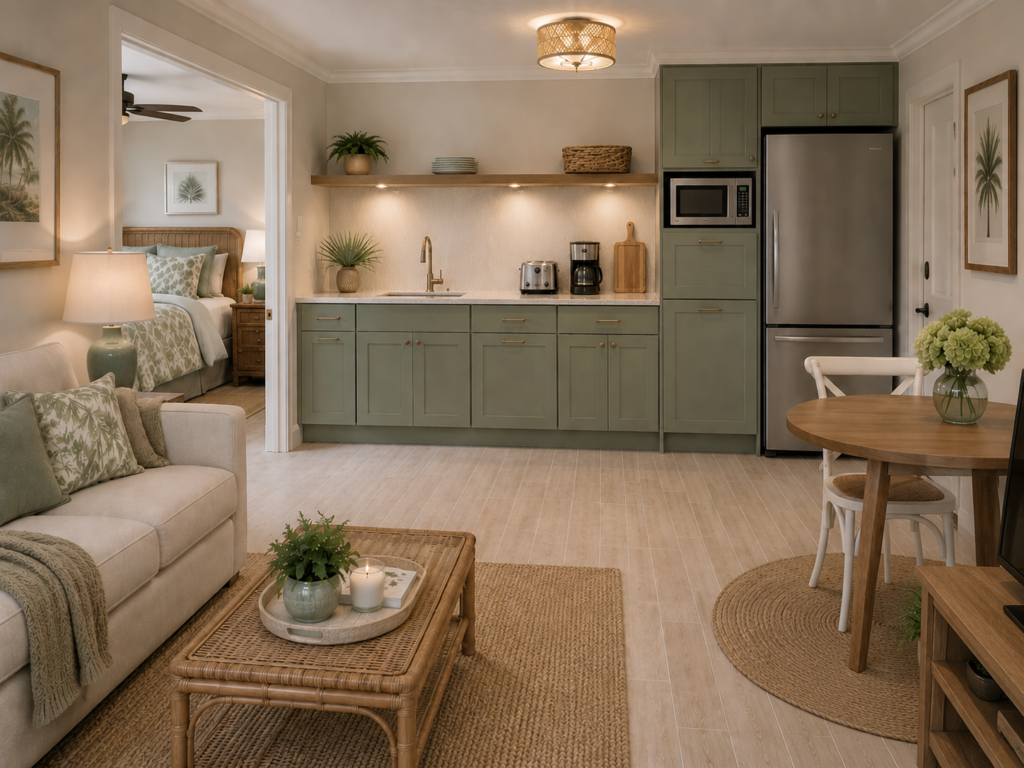
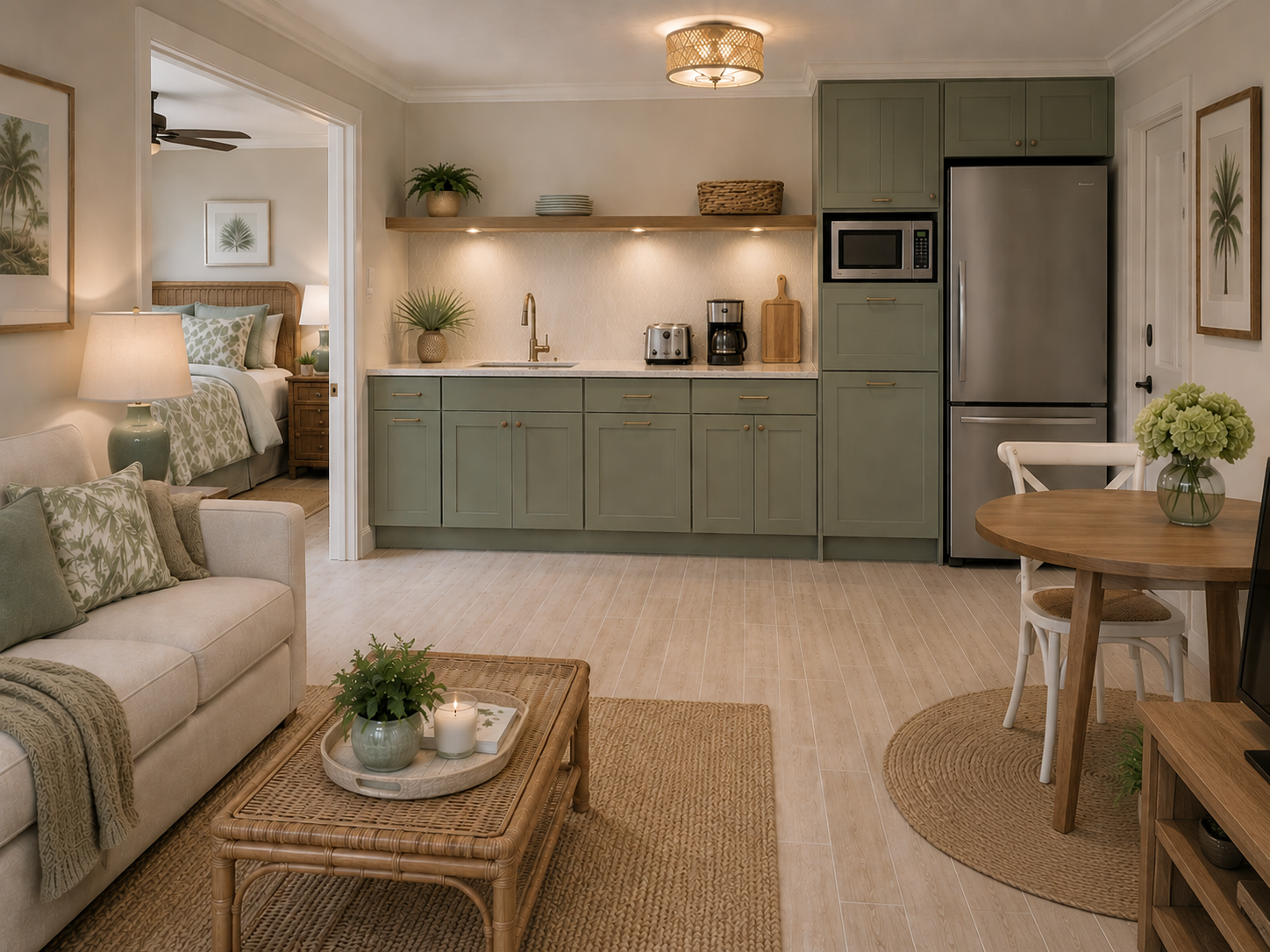
At minimum a sink, fridge, microwave, and cabinet space. A true cooking area is the line between an accessory dwelling and a glorified bonus room in an appraiser’s eyes.
4. Private full bath
Direct from the suite, not down a shared hallway. Non-negotiable for the space to function — and to appraise — as independent.
5. Private laundry
Its own stacked unit, or at minimum a laundry room reachable without crossing the primary living areas. The detail listings almost always overlook — and buyers notice.
A practical note: start with the full five, then strip back only what your family genuinely will not use. But understand the trade — each thing you cut narrows the buyer pool and trims the premium. The suites that add the most value are the ones that need the fewest excuses.
See the five must-haves in a real home
A four-minute walkthrough of what separates a true suite from a downstairs bedroom — the same standard we hold every Florida listing to.
Thinking about selling? Your suite is probably worth more than the estimate says
Online value tools undervalue homes with a real suite, because they read it as ordinary square footage and miss the configuration entirely. The premium is real, but it takes a human valuation to capture it — one that prices the private entrance, the kitchenette, the separation, and the local demand for exactly this kind of home.
Before you list, it is worth getting a number that actually accounts for the suite. We walk through how that valuation works — and what makes these homes worth more than the algorithm thinks — in our Florida multigenerational valuation guide.
Wondering whether to pay up for the suite?
A true suite is one of the few features that reliably holds its value, because demand for multigenerational layouts is expanding, not shrinking. Paying a premium for a genuine suite is usually defensible. Paying it for an “ensuite” that just calls itself a suite is not — and the difference is not always obvious from a listing photo.
The one thing to verify before you pay the premium: permit status. A permitted suite adds value; an unpermitted conversion often adds nothing and can complicate financing. A specialist can confirm what a listing is really offering before you commit.
Common questions
Frequently Asked Questions
Do mother-in-law suites add value to a home?
How much value does a mother-in-law suite add?
Does a mother-in-law suite need a kitchen to add value?
Does an unpermitted mother-in-law suite add value?
Wondering what the suite adds to your specific home? Let’s run a real multigenerational valuation for your Florida market.