

What Is a Mother-in-Law Suite? (And What It’s Not)
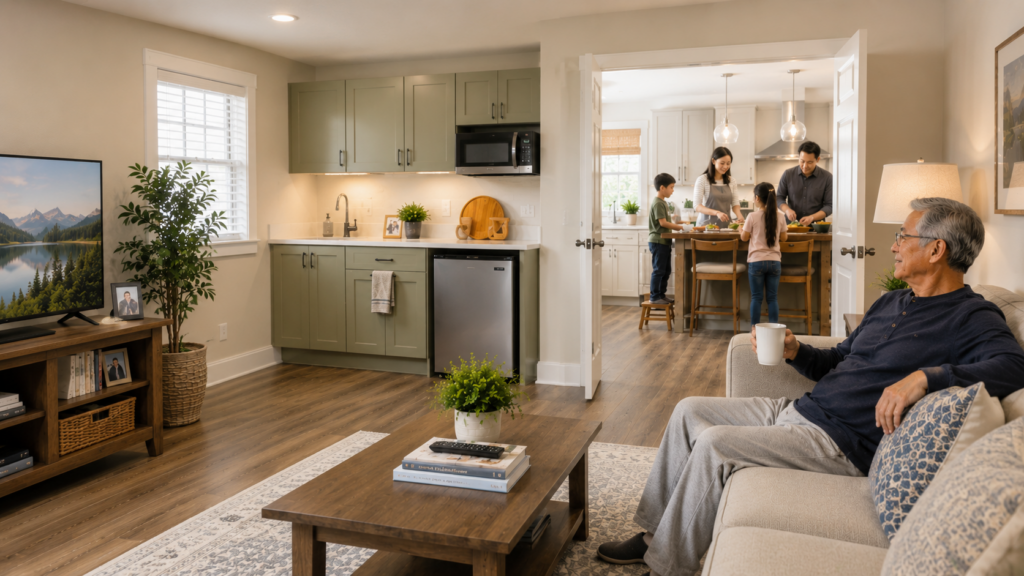
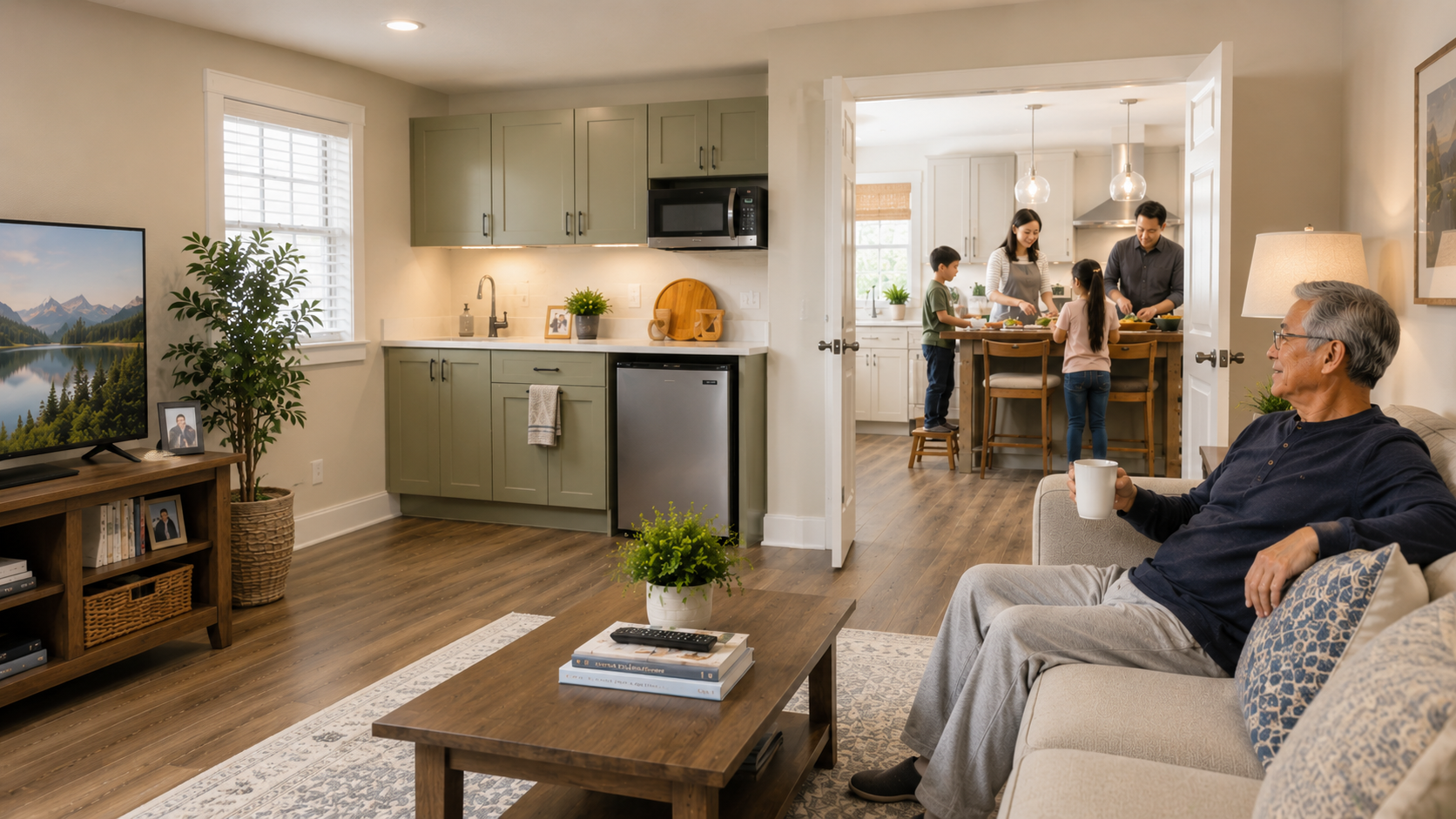
Quick answer: A mother-in-law suite is a private living space — within, attached to, or beside a single-family home — where a parent, adult child, or other family member can live close by while keeping their own independence. The term gets used loosely, though. Most spaces marketed as a “mother-in-law suite” are really just an ensuite bedroom or a second master, with no private entry, living area, or kitchenette. A true suite is closer to two residences at one address: separate enough for dignity, close enough for daily connection.
The label gets stamped on almost anything. Knowing what actually qualifies is the difference between a real second home and a guest room with a fancier name.
When someone says mother-in-law suite, they’re usually picturing a place for a parent to live with the family without everyone living on top of each other. The instinct is right. The label is just doing a lot of heavy lifting.
In real listings, “mother-in-law suite” gets stamped on almost anything: a downstairs bedroom with its own bathroom, a bonus room over the garage, a second master at the back of the house. Sometimes the term fits. Often it doesn’t. The word describes a hope — a family member living comfortably nearby — more than it describes a specific, qualifying space.
That gap between what the term promises and what the space delivers is exactly what trips families up after they move in. So let’s be honest about where the line actually sits.
A bedroom with a bathroom isn’t a suite
Here’s the part most articles skip. A mother-in-law suite is not simply “a bedroom with a bathroom.”
An ensuite bedroom isn’t a suite. A bedroom with its own full bath is a wonderful thing to have — but if the person living there has to walk through your living room to watch their own TV, eat their own breakfast, or do their own laundry, they don’t have independence. They have a nice guest room. For some families that’s genuinely enough, and we’ll come back to that. But it isn’t a true suite.
A second master isn’t a suite either. A large second bedroom with a walk-in closet and a fancy bath is still one room inside your household. No private entry, no living space, no place to prepare a simple meal. It’s a feature of your home, not a home of their own.
And “in-law potential” means there isn’t one yet. When a listing says “in-law potential,” read it literally: the suite does not currently exist. You could build one. That’s a renovation project with a budget, not a move-in-ready multigenerational home.
What actually makes it a suite
We help families buy and sell these properties every day across Florida, and we hold to a real standard. A true suite isn’t a big house with an extra bedroom — it’s two functional spaces under one roof (or one detached beside it). At full spec, that means five things.
Start with the full five, then strip back
Every family is different. Some don’t need a full kitchen; some are perfectly happy with a twin bed and a recliner. The point of the five isn’t to disqualify your situation — it’s to know what a complete suite looks like so you can decide which pieces you actually need. The rule we give every family: start with all five, then let go only of what you genuinely don’t need. If you’re compromising because the home forced you to — not because you chose to — you’ll feel it within the first month.
Suite vs. guest house vs. casita
These terms get used interchangeably in listings. They aren’t the same, and the differences change what you can do with the space. A mother-in-law suite (also in-law suite or in-law quarters) is a private living space attached to or within the main home. A guest house or casita is a detached, standalone structure beside the home — usually the strongest physical separation you can get. An accessory dwelling unit is the legal classification a city may apply once a space has its own full kitchen and entrance; it’s a permitting term, not a marketing one. And multigenerational home is the umbrella all of these live under.
Whatever the label, the test is the same. The standard doesn’t change just because the structure does.
Why “separate but together” is the whole point
The reason we’re firm about real separation isn’t pickiness — it’s that the research is firm about it too. Decades of work tie social isolation to a higher risk of early death, on a scale researchers compare to smoking, while strong social ties raise survival odds by roughly 50%. The Pew Research Center counts about 59.7 million Americans now living in multigenerational households — four times the figure from 1971.
But the same research flags the failure mode, and it’s blunt: closeness heals, forced closeness without autonomy does the opposite. When there’s no door to close and no space to retreat to, the benefit erodes and the friction takes its place. That’s the entire case for a true suite. Close enough for shared dinners and grandkids within earshot — separate enough that everyone keeps their dignity.
Close, by design
Shared meals, easy drop-ins, and grandchildren within earshot — the daily connection the longevity research rewards, built into the floor plan.
Separate, by dignity
A private entrance, a full bath, a kitchenette, a door that closes. Independence preserved is the variable that keeps togetherness healthy.
Three things to check on a showing
Look for plumbing, not labels. A room with cabinets and a fridge gets marketed as a “kitchenette,” but the question that matters is whether it has a sink with real plumbing. Adding it later runs $3,000–$8,000 or more once you factor in water supply and drainage. No plumbing means it’s a bedroom with a fridge.
Check the HVAC zones. If the suite shares one thermostat with the main house, you’ve got thermostat wars waiting to happen — and in Florida, people have strong opinions about the A/C. Ask whether the suite has its own zone.
Look for closets. People need somewhere for towels, clothes, the vacuum, the Costco toilet paper. If the only storage is one small bedroom closet, it’ll feel cramped fast.
Not sure if a home actually qualifies?
We specialize exclusively in multigenerational homes — in-law suites, casitas, and detached ADUs. Send us a listing and we’ll tell you honestly whether it’s a real suite or a guest room with a label.
Serving families across Florida · No pressure, just guidance
Common questions