

Aging in Place in a Multigenerational Home: A Florida Family’s Guide
Quick answer: Aging in place in a multigenerational home means choosing a house that works through every phase — independence, light support, and active caregiving — so an aging parent never has to move again at the worst possible moment. The features that matter most are a single-story or zero-step entry to the suite, wide (36-inch) doorways, a curbless shower, lever handles, reinforced bathroom walls for grab bars, and a suite located near the entry and kitchen. Florida is unusually well suited to this, with abundant single-story construction and no basements.
When an aging parent moves into a multigenerational home, the right layout becomes one of the most important decisions a family will make. Here is what to look for, what to avoid, and why getting it right matters.
Most articles about aging in place are written for people aging alone in their own homes — adults preparing to modify the house they have lived in for decades. That advice works for some families. For multigenerational households, where an aging parent moves into a home shared with adult children, the planning happens differently.
In a multigenerational setup, the right home is purchased before the modifications are needed. The suite, the layout, and the access are already in place. The goal is to find a home that works not just at move-in, but five years later, ten years later, and at the end of life — without requiring another move when health and mobility change.
Florida is one of the more accommodating states for this kind of planning. No basements means no stairs separating an aging parent from the main living area. The state has more single-story new construction than most northern markets. Major health systems concentrate in several Florida regions. And the state’s 2025 ADU law has expanded options for adding suites to existing homes. Getting the right home requires knowing what to look for — and what to walk away from.
If you are starting this conversation now, our guide to recognizing when multigenerational living makes sense → covers the decision framework. This article focuses on what to look for in the home itself.
The right home doesn’t just work today. It works through independence, through light support, through active caregiving — without requiring another move.
What aging in place actually means in a multigenerational setup
Aging in place is not the same as aging alone. In a multigenerational home, it means the parent ages with proximity to family support — not isolated, not institutionalized, not at the mercy of strangers. The home becomes the infrastructure that makes this possible.
There are three phases to plan for:
Most homes are designed for one phase, not all three. A home that’s perfect for Phase 1 but impossible for Phase 3 forces another move at exactly the wrong moment — when health is declining, when the family is already overwhelmed, when stability matters most. The right home accommodates the full arc.
Six home features that enable aging in place
These are the features we screen for during property review. Each one matters more than buyers realize until the moment they are needed.
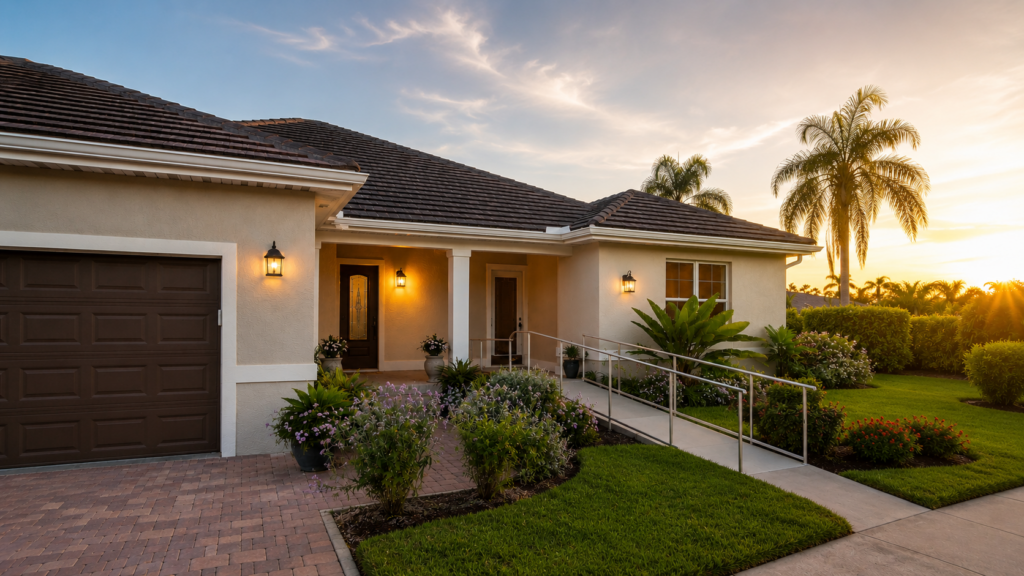
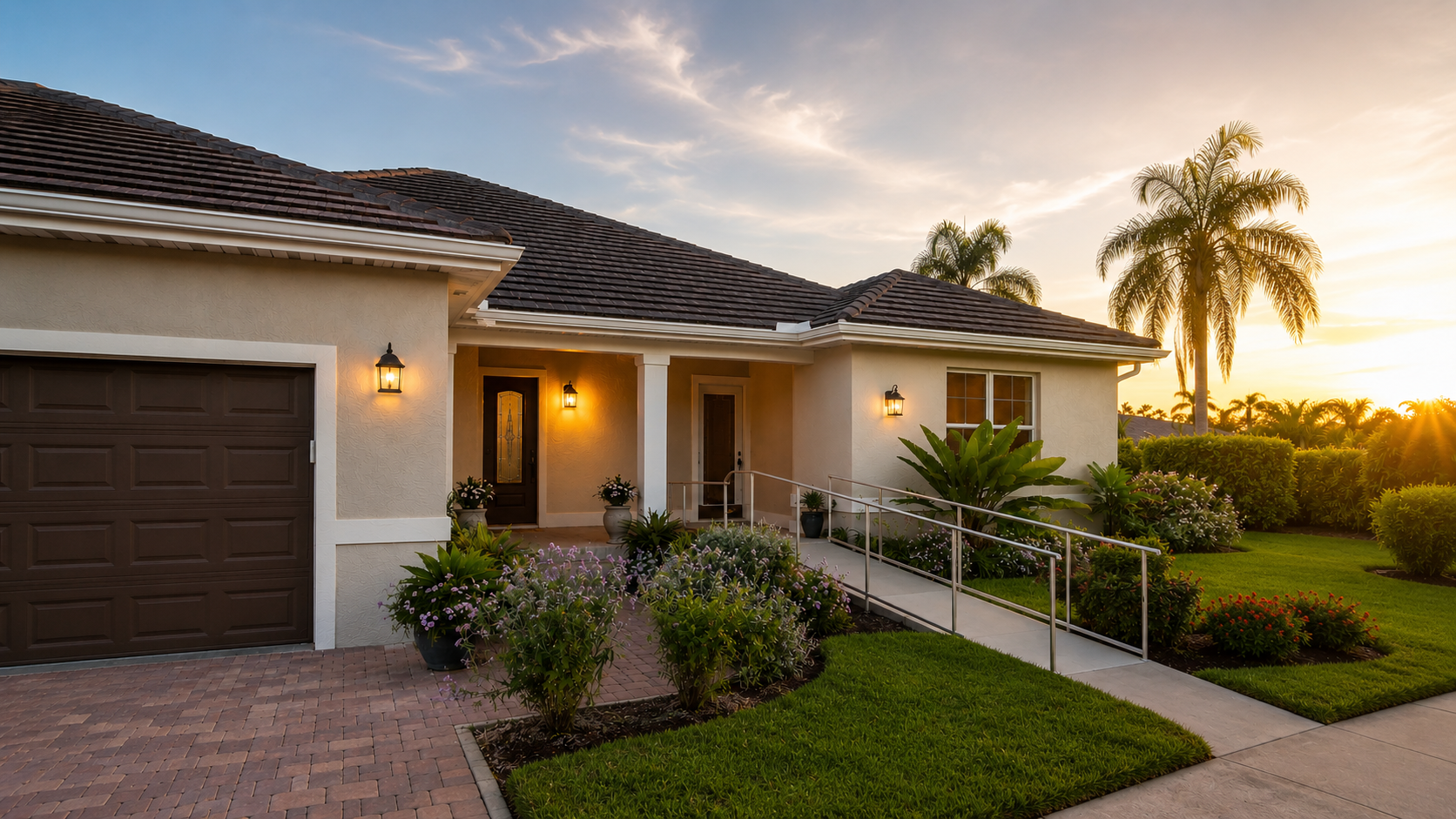
Stairs become impossible during recovery from surgery, after a fall, or as mobility declines. A single-story home — or at minimum a ground-floor suite with no steps at the entrance — preserves access through every phase. Florida has substantially more single-story new construction than most northern markets, making this easier to find here than elsewhere.
What to look for during a tour: walk from the driveway to the suite. Count every step.
Wheelchairs, walkers, and home health equipment all need width. Standard interior doorways are 28-32 inches — often too narrow for assistive devices. Universal design recommends a 36-inch minimum. New construction increasingly meets this standard; older homes often do not.
What to look for during a tour: bring a tape measure. Check the suite bedroom, bathroom, and primary hallway.
The bathroom is where most aging-in-place falls happen. A curbless shower — one with no lip or threshold — allows wheelchair access, accommodates a shower chair, and prevents tripping during transfers. Retrofitting a traditional shower into a curbless one is expensive and disruptive. Buying a home that already has one is significantly easier.
What to look for during a tour: examine the shower entry. A curb of any height creates a fall risk.
Arthritis makes round doorknobs and small toggle switches difficult. Lever-style door handles and large rocker light switches require minimal grip strength. A small detail — but one that affects daily quality of life. These are easy to retrofit, but a home with them already installed signals attention to thoughtful design.
What to look for during a tour: try opening doors with a closed fist. If you cannot, neither can someone with arthritis.
Grab bars need to attach to wall studs or solid backing — not drywall. Many newer multigenerational floorplans include reinforcement in bathroom walls during construction, even if grab bars are not installed yet. This makes future installation straightforward instead of structural. Worth asking the builder, the seller, or the inspector.
What to look for during a tour: ask directly. Most sellers do not volunteer this information.
A suite at the far end of a 3,500-square-foot home becomes isolated as mobility declines. The best layouts position the secondary suite near the main entry, within reasonable distance of the kitchen, and with access to a private outdoor area — a small porch or patio that allows the parent to be outside without requiring a long interior walk.
What to look for during a tour: walk from the suite to the kitchen, the front door, and the nearest outdoor space. Note the distance.
What matters specifically in Florida
Hurricane planning takes on a different weight with limited-mobility residents. Florida evacuation routes can be hours-long. Inland positioning — Polk County, parts of Central Florida, inland Lee and Charlotte counties — makes evacuation significantly easier than coastal positioning. For families with an aging parent or anyone with mobility challenges, this is a serious consideration, not an afterthought.
Hospital proximity matters more than it does for younger buyers. Aging parents typically have more frequent medical needs. Florida has exceptional medical infrastructure in some regions — AdventHealth Orlando, Tampa General, Lee Health, Sarasota Memorial, the Mayo Clinic Florida campus in Jacksonville. Other parts of rural Florida have only basic urgent care available. Worth verifying which health systems serve a target area before committing.
Single-story new construction is unusually common in Florida. Northern markets often default to two-story homes to maximize lot use. Florida’s larger lots and warmer climate make single-story construction standard in most master-planned communities. This makes Florida an unusually accessible state for aging-in-place planning.
The 2025 ADU law expanded options for existing homes. If your family already owns a Florida property and needs to add space for an aging parent, the new statewide ADU law makes that significantly more feasible than in past years. Our guide to the new Florida ADU law → covers what that means in practice.
The long-term value of buying with aging in place in mind
Many buyers underestimate the cost of not planning ahead. Each shortcut in the home-buying decision compounds later, often during a moment of medical crisis when stability matters most.
The cost of moving twice. Families who buy a home that works for Phase 1 but cannot accommodate Phase 2 or 3 face a second purchase — typically $50,000 to $100,000 in transaction costs alone (commissions, closing costs, moving expenses), not counting the emotional cost of relocating an aging parent who has already adjusted to one home.
The cost of major retrofits. Widening doorways, replacing a traditional shower with a curbless one, adding ramps, and reinforcing walls for grab bars adds up quickly — often $40,000 to $80,000 in a home that was not designed for it. Buying a home where these features already exist eliminates this entirely.
The cost of avoided facility care. Florida assisted living runs $4,000 to $12,000 per month per resident. Memory care runs higher. Even one year of avoided facility care often pays for substantial home modifications — and aging in place is what most parents actually want. Our cost comparison guide → walks through the math.
Resale value. Homes designed for aging in place do not lose value — they gain it. Florida’s aging population means demand for these homes is growing. A home that works for a multigenerational family today will appeal to similar buyers when the time comes to sell.
What to avoid when planning for aging in place
The right home anticipates these moments. The wrong home requires a second crisis-driven move.
Why this work matters to us
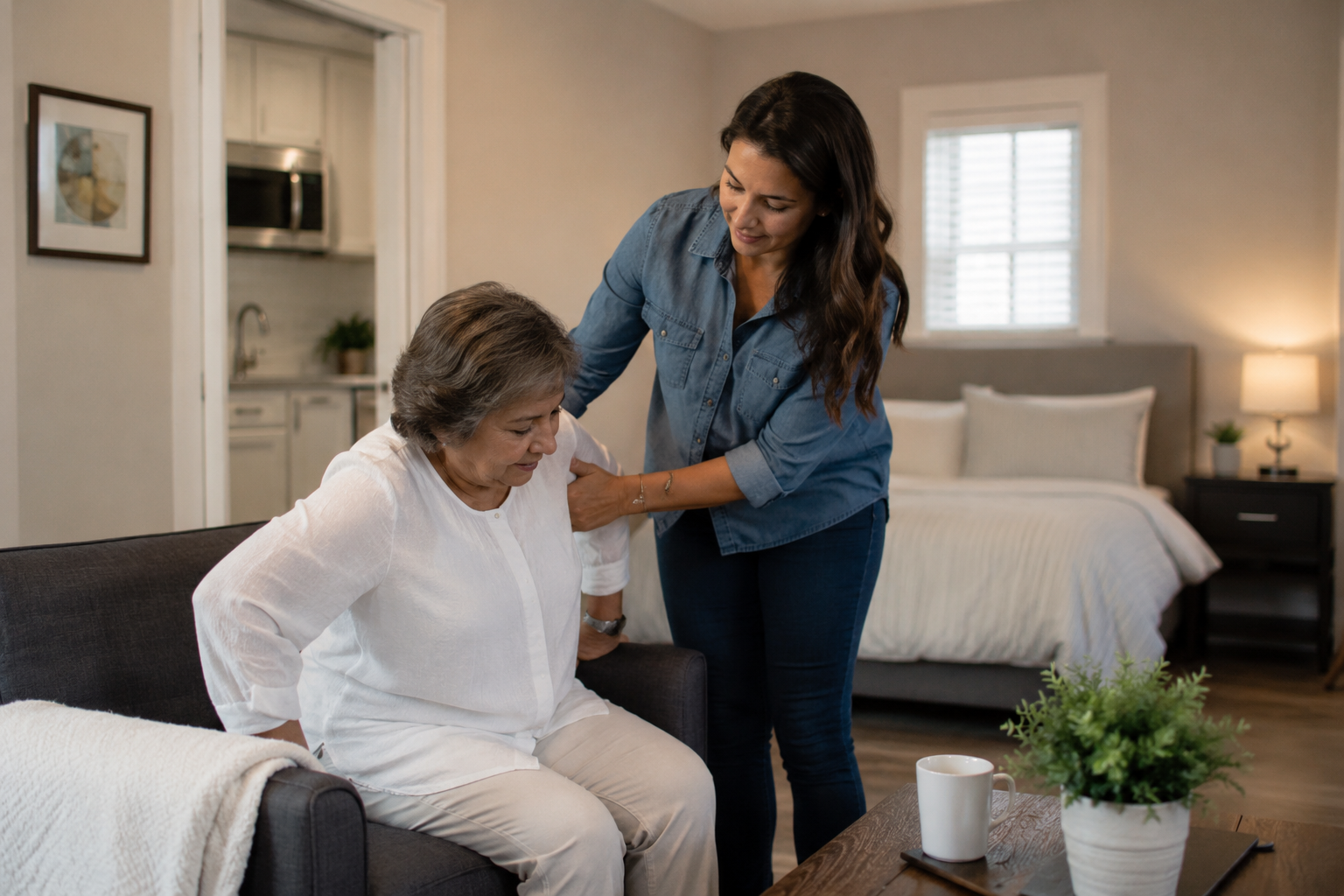
We started MultiGen Living Group because we lived this. Both of our families navigated aging parents — not from a distance, but in the day-to-day work of trying to keep them home, in a setting that respected who they were.
What we learned:
The right home matters more than most families realize. A house that works when a parent is independent doesn’t necessarily work when mobility changes, when memory shifts, when the daily routine has to be supported. Families who plan for the full arc — independence, light support, active caregiving — give themselves and their parents more time, more dignity, and more peace.
We’re not anti-facility. Some families need assisted living or memory care, and those decisions are made with love. But we believe many families who end up in facilities could have stayed home longer if the home had been right from the start. That’s the work we do — helping families find homes that support the entire aging journey, not just the moment they buy.
Along the way, we’ve come to deeply appreciate the people who make aging in place possible. Home health aides, hospice nurses, social workers, CNAs, physical therapists — the quiet teams who show up day after day. We saw this firsthand near the end of one parent’s life. His entire hospice team — the doctor, nurse, social worker, CNA, and physical therapist — rearranged their schedules to be at his in-law suite for his 84th birthday. Five professionals. They planned the whole thing for him. That kind of care isn’t anonymous, and it isn’t transactional. It’s the work of people who treat their patients like family.
The right home made that possible. He was in a space that felt like his own, surrounded by family, with a team that knew him. When the time came, he was at peace — and so were we, because we knew we had done right by him.
For us, helping families build that kind of arrangement isn’t just real estate. It’s the work that mattered most for our own families. It’s what brought us here.
What we do for families planning aging in place
We screen for aging-in-place compatibility during initial property review. Doorway widths, single-story configuration, bathroom layout, suite proximity, and HOA restrictions — these are part of our standard screening, not afterthoughts.
We connect families with trusted home modification specialists. If a property is otherwise right but needs specific modifications, we have relationships with contractors who specialize in aging-in-place renovations.
We coordinate with healthcare planners, elder law attorneys, and Lady Bird deed specialists when situations call for it. A multigenerational home purchase often touches estate planning, Medicaid considerations, and family caregiving agreements. We know who to bring into the conversation.
We search across all five Florida regions. Most aging-in-place searches benefit from comparing options across regions — inland Central Florida for hurricane considerations, Tampa Bay for medical infrastructure, Sarasota for new construction, Southwest Florida for acreage and detached options. We work across all of them.
Common questions
Frequently asked questions
What home features matter most for aging in place?
Why is Florida well suited for aging in place?
What is the difference between a guest bedroom and an aging-in-place suite?
Is it cheaper to buy an aging-in-place home or retrofit one later?
Planning a Florida home that will support an aging parent — now or in the years ahead? We help families find homes that work for the entire journey.