

Florida ADU Laws in 2026: The Current Reality for Multigenerational Buyers
Quick answer: Despite widespread reports, Florida did not pass a statewide ADU mandate — the bills (SB 48 / HB 313) failed in both 2025 and 2026. Florida’s ADU rules remain a county-by-county and city-by-city patchwork governed by local zoning and HOA covenants, with no obligation for any city to allow them. Whether you can build, buy, or use an ADU depends entirely on the specific property, its local government, and its HOA — so verify all three before counting on ADU rights.
If you’ve read that Florida just passed a sweeping statewide ADU law, you’ve read something inaccurate. Here’s what the legislature actually did, what it didn’t do, and what it means for families considering an accessory dwelling unit on a Florida property.
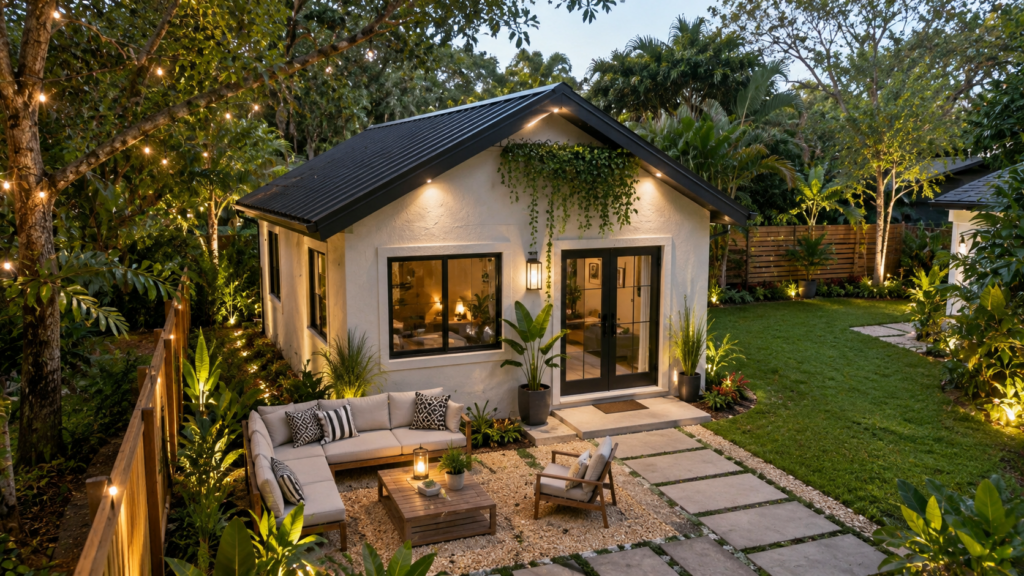
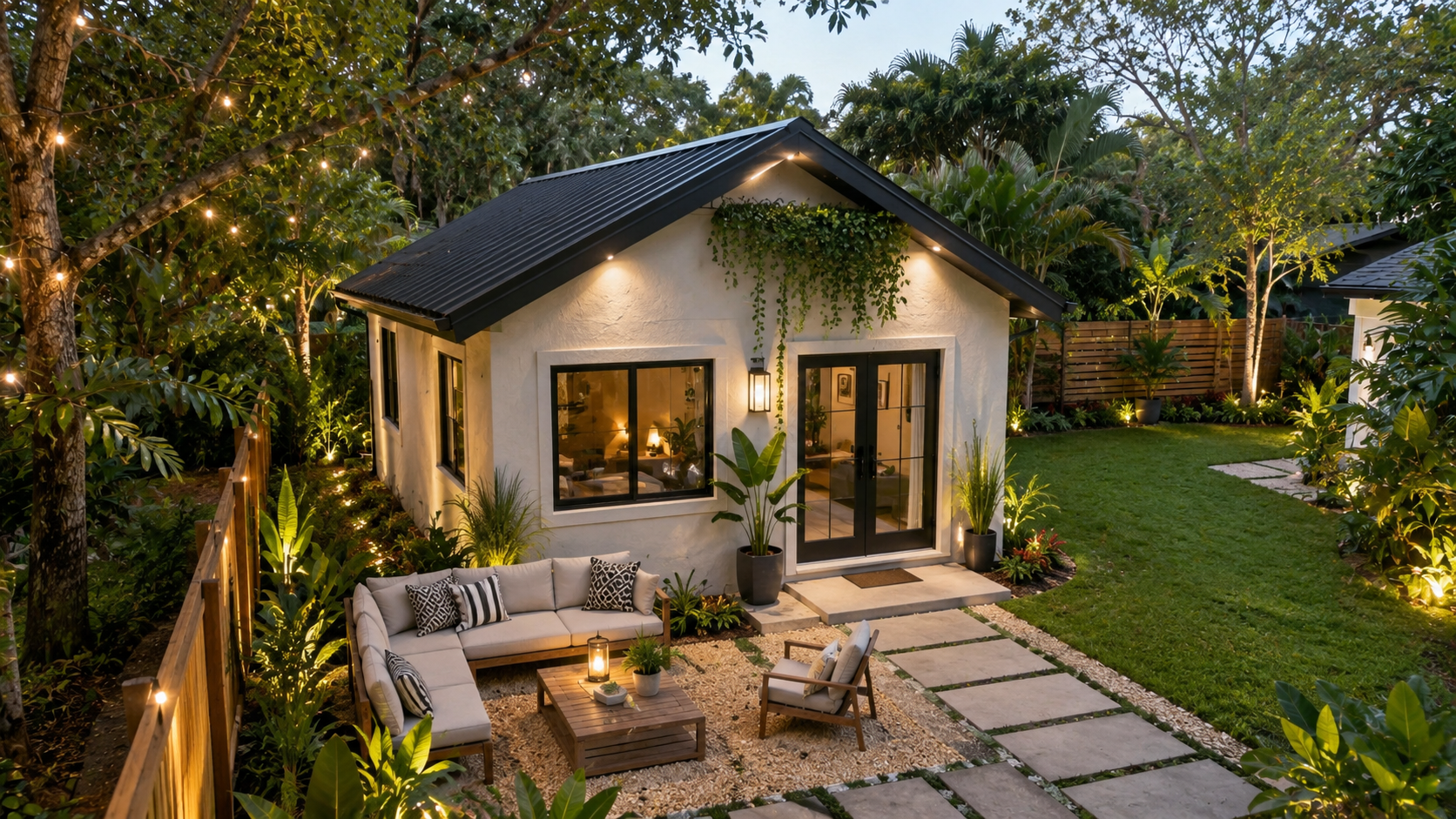
Accessory dwelling units — sometimes called ADUs, granny flats, in-law suites, casitas, or carriage houses — are small secondary homes built on the same property as a primary residence. For multigenerational families, ADUs offer something traditional single-family homes cannot: genuine separate living for an aging parent, an adult child, or a future caregiver, while keeping everyone on the same property.
Florida has been having a serious conversation about ADUs for several years now. Twice — in 2025 and again in 2026 — the legislature considered bills that would have required every Florida city and county to allow ADUs by right in single-family zones. Both times, the bills failed.
A separate affordable housing bill, House Bill 1389, did pass the 2026 session and addresses Florida’s broader Live Local Act. It includes a narrow ADU provision related to property tax exemptions for ADUs used as affordable rental housing — but it does not create the statewide ADU mandate that was widely discussed.
This matters because a lot of online content (and some local news coverage) has conflated these bills. Buyers researching Florida ADU rules in 2026 often arrive with the impression that everything is about to change on December 1, 2026. That impression is wrong, and acting on it can lead to real problems — buying a property based on assumed ADU rights that don’t actually exist.
This guide walks through what’s actually true, what’s not, and what Florida buyers and homeowners genuinely need to verify before counting on an ADU on a specific property.
Florida’s ADU rules remain a county-by-county and city-by-city patchwork. There is no statewide mandate. Whether you can build, buy, or use an ADU depends entirely on the specific property, its local government, and its HOA.
What Florida lawmakers actually did — and didn’t do
Two separate legislative efforts have shaped the Florida ADU conversation in recent years. Understanding which bills passed and which didn’t is essential for any buyer making decisions based on the legal landscape.
2025 Session: SB 184 / HB 247. The original ADU mandate bills sponsored by Sen. Don Gaetz and Rep. Danny Nix would have required all Florida local governments to allow ADUs by right in single-family zones by December 1, 2026. The bills advanced through committees and gathered bipartisan support, but stalled in the final days of the 2025 session over disagreements about how to handle short-term rental restrictions.
2026 Session: SB 48 / HB 313. Essentially the same bills, refiled for the 2026 session. The Senate passed SB 48 unanimously (35-0) on February 4, 2026. The House passed companion legislation. However, the two chambers couldn’t reconcile their versions before session ended on March 13, 2026, and the bills died. The official Florida Senate record shows SB 48 “Died in Messages” — meaning it failed in the final procedural stage.
2026 Session: HB 1389 (passed). A separate affordable housing bill amending the Live Local Act passed both chambers in March 2026 with strong bipartisan support (House 98-4, Senate 35-0). Earlier drafts contained ADU provisions, but those were stripped before final passage when the chambers couldn’t agree on short-term rental rules for ADUs. The bill’s ADU-related impact is narrow: it allows ADUs to qualify for affordable housing property tax exemptions when rented to low- or moderate-income tenants meeting specific criteria.
What this means in plain terms: Florida did not pass a statewide ADU mandate. The bills that would have done so failed in both 2025 and 2026 sessions. The bill that did pass (HB 1389) addresses affordable housing more broadly and includes a tax exemption pathway for ADUs used specifically as affordable rentals — a provision unlikely to apply to most multigenerational family situations.
What actually governs Florida ADUs in 2026
In the absence of a statewide mandate, three sources of authority determine whether you can build, buy, or use an ADU on a specific Florida property:
Florida Statute 163.31771. This existing state law “encourages” but does not require local governments to allow ADUs. It establishes a framework that cities and counties may adopt voluntarily, but it imposes no obligation. Most Florida local governments have not adopted ADU-friendly ordinances under this framework.
Local zoning and land use codes. Each Florida city and county sets its own ADU rules, which vary dramatically. Some allow ADUs by right in single-family zones. Some require special use permits or conditional approvals. Some prohibit them outright. The rules can also differ between zoning districts within the same city.
HOA covenants and deed restrictions. Private homeowners associations can prohibit ADUs even when the city allows them. Florida law generally treats HOA covenants as enforceable private contracts. A property may sit in a city that fully allows ADUs while being subject to an HOA that prohibits them entirely.
The practical implication: there is no single answer to “can I build an ADU in Florida?” The answer depends on the specific property and requires verifying all three sources before making any decision based on assumed ADU rights.
How Florida cities approach ADUs today
A rough sense of where things stand across Florida’s major markets, though specific rules can change and any decision should be verified directly with the local government before relying on it.
Generally ADU-friendly
Tallahassee, Gainesville, Tampa, parts of Orlando, St. Petersburg, and certain unincorporated areas of Orange County have established programs that allow ADUs under defined conditions. Orange County’s “Ready Set Orange” program even offers pre-designed floor plans to streamline approval.
Conditional or restricted
Many Florida cities and counties allow ADUs but impose meaningful restrictions: minimum lot sizes, owner-occupancy requirements, limits on rentals, design standards, or discretionary approval processes. The rules in these jurisdictions often make ADUs technically legal but practically difficult.
Restrictive or prohibitive
Many Florida jurisdictions either prohibit ADUs in most single-family zones or impose requirements so burdensome that construction is impractical. This is especially common in newer master-planned communities and areas with restrictive HOA structures.
Acreage and rural
Florida’s agricultural-residential zoning corridors typically allow multiple residential structures on a single parcel without the restrictions found in suburban single-family zones. Acreage properties are often the easiest path to legal ADU configurations in Florida.
For a buyer prioritizing ADU flexibility, the cleanest path is often to focus on properties where the local rules and the HOA situation (or absence of HOA) already permit what you want to do, rather than betting on rule changes that may or may not materialize.
HB 1389 and what it actually means for ADUs
HB 1389 — the 2026 affordable housing bill that did pass — is primarily an amendment to Florida’s Live Local Act, which addresses affordable housing development at scale. The bill’s main provisions affect multifamily developers, religious institutions wanting to develop affordable housing on their property, and local governments’ ability to opt out of affordable housing tax exemptions.
The ADU-specific provision is narrow. HB 1389 allows ADUs to qualify for affordable housing property tax exemptions of up to 100% of the assessed value, but only when the ADU meets specific affordability criteria — meaning it must be rented to low-income or moderate-income tenants at qualifying rental rates for an extended affordability period.
For most multigenerational families, this provision does not apply. If you’re housing an aging parent, an adult child, or another family member in your ADU, you’re not renting at qualifying affordable housing rates to income-qualified tenants, and you wouldn’t claim the exemption. The provision is structured for landlords providing affordable rental housing, not for families using ADUs for family members.
The bill’s effective date is July 1, 2026, contingent on the Governor’s signature. As of this writing, Governor DeSantis has not yet signed the bill.
What to verify on any Florida property where ADUs matter
Whether you’re buying a property with an existing ADU, planning to add one, or considering a property that might support one in the future, several items need direct verification — not assumption.
A specialist agent works through these items before you commit, not after.
Types of ADUs that work for multigenerational families
Different configurations suit different family priorities, lot conditions, and budgets. Local rules may permit some types but not others on a given property.
Detached ADU
A standalone structure on the same lot with its own entrance, full bathroom, kitchen, and living area. The strongest physical separation available.
Best for: aging parents or adult children needing real independence, or rental income separate from the main home.
Attached ADU
A wing of the main home with shared structural elements but a private entrance and self-contained living spaces.
Best for: caregiving arrangements where quick response matters, or smaller lots where detached construction is impractical.
Garage conversion
An existing garage converted into a residential unit. Typically less expensive than new construction since the structure already exists.
Best for: properties with detached garages and homeowners working within tighter budgets.
Above-garage suite
An apartment built above a detached or attached garage, accessed by an exterior staircase. Provides full separation while preserving yard space.
Best for: smaller lots where detached construction is not feasible, or properties valuing yard preservation.
The HOA question — where state law has limits
Even if Florida had passed a statewide ADU mandate (and even if a future legislative session does), one factor would remain unchanged: homeowners associations are private contracts, and they can prohibit ADUs regardless of what state or local law allows.
In Florida, a substantial portion of newer single-family communities have HOA covenants restricting accessory structures, secondary residences, or rental of any kind. These restrictions are private agreements that property owners accepted when purchasing in the community. State legislation has historically not invalidated them.
For multigenerational buyers, the HOA question is the most overlooked aspect of the ADU decision. A property may be in a city that fully allows ADUs while sitting in an HOA that prohibits them entirely.
Before purchasing any property with the intent to add an ADU, review the HOA covenants in writing and confirm directly with the HOA board. Many wealthy enclaves and master-planned communities have restrictive covenants that effectively prevent ADU construction even where the city would allow it.
Already own a Florida property? Here’s how to assess ADU feasibility
If you already own your Florida property and are wondering whether you can add an ADU — for an aging parent, an adult child, a future caregiver, or another reason — the path forward involves three steps:
First, verify zoning and local rules. Before spending money on plans, confirm whether your specific property’s zoning permits an ADU and what configuration the local ordinance allows. This is where many homeowners get stuck — assuming their property qualifies when it doesn’t, or vice versa.
Second, review HOA covenants. Even if the city allows it, your HOA may not. Get the covenants document and review it carefully, or have a real estate attorney review it for you.
Third, work with a builder who knows the local permitting process. Florida ADU construction varies significantly by jurisdiction. Builders who specialize in your county will navigate the permit process more efficiently than generalists.
We can help with the first two steps and connect you with trusted Florida ADU builders for the third. This work is part of why we exist as a brokerage focused exclusively on multigenerational housing.
When an ADU makes sense for a multigenerational family
An ADU is the right answer for some families and the wrong one for others. The decision depends on the property, the family situation, and the timeline.
An ADU usually fits when: the property has the lot size and zoning to support it, the family wants genuine separation rather than shared interior space, the timeline allows for design and construction (typically 6–18 months from planning to completion), and the budget supports the investment alongside any necessary site preparation.
A purpose-built multigenerational home may fit better when: the family wants the secondary suite ready immediately, the property doesn’t have lot capacity for a detached structure, or the buyer prefers attached suite configurations with shared structural elements.
A resale home with an existing ADU often makes most sense when: the property is in a market with established ADU inventory, the existing structure already meets the family’s configuration needs, and the buyer wants to avoid construction timelines.
For families weighing all three paths, we can walk through the tradeoffs based on your specific situation, target market, and timeline.
Will Florida pass a statewide ADU mandate eventually?
Possibly. The 2025 and 2026 bills both came close to passing — failing on procedural issues and disagreements over short-term rental provisions, not on opposition to the underlying idea. Both bills had bipartisan support and were sponsored by the same legislators in each session.
Industry observers expect ADU legislation to return in the 2027 session, likely with revised language addressing the short-term rental concerns that derailed the 2026 effort. Whether it passes will depend on whether legislators can resolve the disagreement that has stalled the bill for two consecutive sessions.
For multigenerational buyers making decisions now, the practical implication is to plan based on current rules, not anticipated rules. A property that works for your family under today’s local ordinances will continue to work regardless of what happens in 2027. A property that depends on rule changes that may or may not pass is a riskier proposition.
Florida ADU laws — frequently asked questions
Did Florida pass a statewide ADU law in 2026?
No. SB 48 and HB 313 — the bills that would have required local governments to allow ADUs by right in single-family zones — failed in March 2026. The official Florida Senate record shows SB 48 died in the final procedural stage. This was the second consecutive year an ADU mandate bill failed.
What about HB 1389 — didn’t that pass?
Yes. HB 1389 passed in March 2026 and amends the Live Local Act. It includes a narrow provision allowing ADUs to qualify for affordable housing property tax exemptions when rented to low- or moderate-income tenants. This provision does not apply to ADUs used for family members. The bill is awaiting the Governor’s signature as of May 2026.
Can I build an ADU in my city?
It depends entirely on your specific city and zoning district. Some Florida cities allow ADUs under existing ordinances; others restrict or prohibit them. The rules can vary even within the same city across different zoning categories. Verify with your local planning or building department before assuming.
Can my HOA prevent me from building an ADU?
Yes. HOA covenants are private contracts that bind property owners regardless of what state or local law allows. Many Florida HOAs prohibit ADUs entirely. Reviewing the HOA documents before purchasing is essential.
How long does it take to build an ADU in Florida?
Most ADU projects take 6 to 18 months from planning to completion, depending on the configuration, permitting timeline in your jurisdiction, and construction complexity. Garage conversions are typically faster than new detached construction.
How much does an ADU cost in Florida?
New detached ADUs in Florida typically run $80,000 to $200,000+ depending on size, finishes, and site preparation. Garage conversions and attached ADUs often cost less due to existing structure. Site preparation, utility upgrades, and permitting fees add to the total.
Will Florida pass an ADU mandate in 2027?
Possibly. The 2025 and 2026 bills both failed over disagreements about short-term rental restrictions, not over the broader concept. Legislators are expected to refile in 2027 with revised language. Whether it passes will depend on resolving those disagreements. For now, plan based on current local rules, not anticipated changes.
Where a specialist agent earns their seat at the table
Florida’s ADU landscape is messy. The rules vary by city, by county, by zoning district, and by HOA. The legislation that gets discussed in the news isn’t always the legislation that passes. And the practical reality of what you can build on a specific property requires verification that most generalist real estate agents don’t routinely do.
We work in this category every day. We know which Florida markets have established ADU programs, which have restrictive rules, and which have inventory that already includes secondary structures. We pull permit records, review HOA covenants, and verify zoning before recommending offers — not after.
If you’re considering a Florida home with an existing ADU, planning to add one to a property you’d like to buy, or wondering whether your existing home qualifies — we can walk through the specifics of your situation.
See current Florida ADU resale homes →
Free access. Refreshed weekly.
Common questions
Frequently asked questions
Did Florida pass a statewide ADU law in 2026?
Can my HOA prevent me from building an ADU in Florida?
How much does it cost and how long does it take to build an ADU in Florida?
What should I verify before counting on an ADU on a Florida property?
Have questions about ADU feasibility on a specific Florida property? Let’s walk through it together.