

What New Realtor.com Data Tells Us About Multigenerational Living in Florida
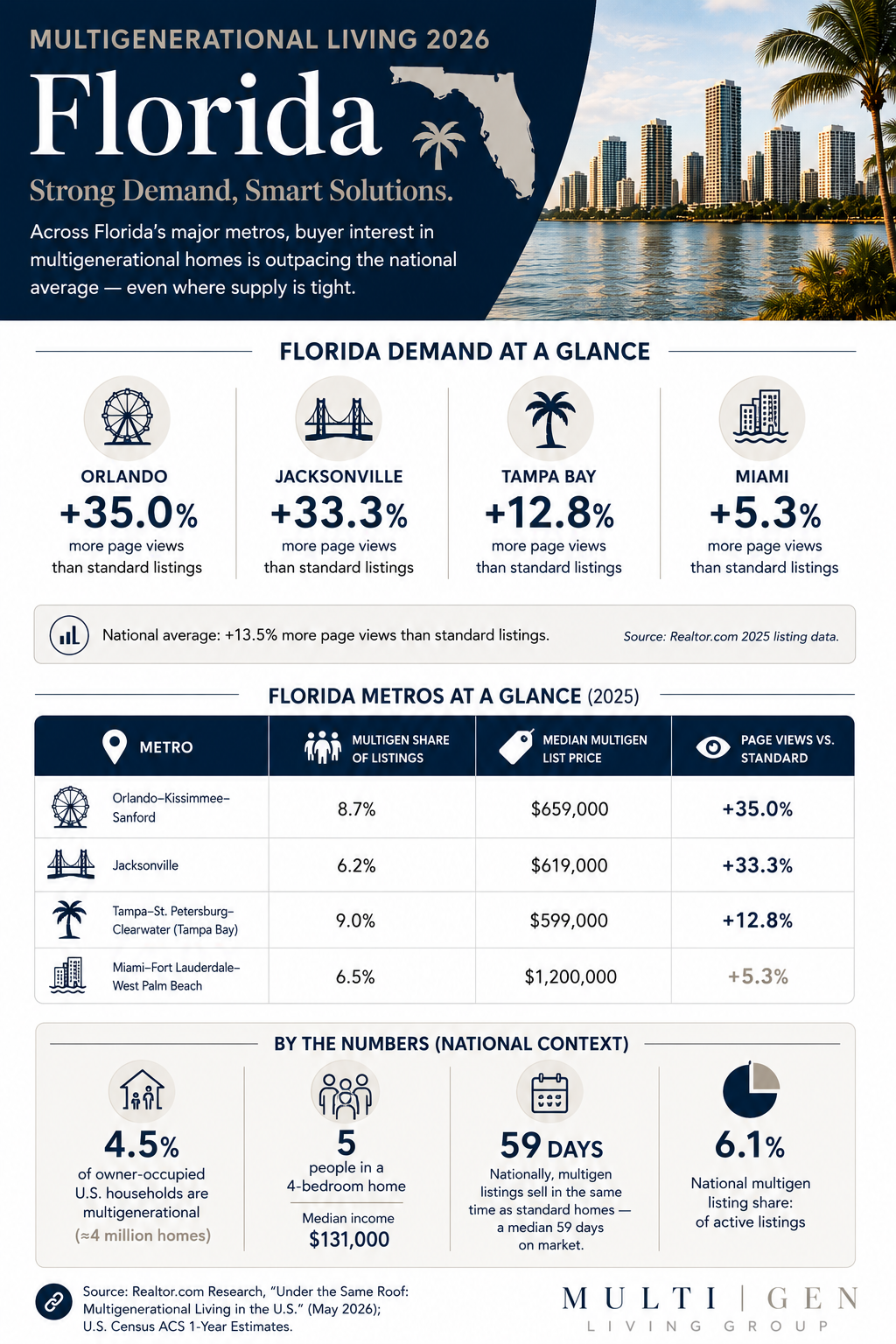
Quick answer: New Realtor.com research (May 2026) shows Florida is one of the strongest multigenerational housing markets in the country. All four major metros sit at or above the 6.1% national average for multigen listings — led by Tampa Bay (9.0%) and Orlando (8.7%) — and buyer demand is outpacing supply, especially in Orlando (+35% page views) and Jacksonville (+33%). Notably, Florida’s per-square-foot premiums are small (just 2.1% in Orlando), so buyers are paying for more house, not a luxury upcharge.
New Realtor.com research shows Florida is quietly one of the strongest multigenerational housing markets in the country. Here is what the data actually says — and what it means for Florida families.
Realtor.com released new research this month showing that multigenerational living continues to reshape the American housing landscape. While the headlines focus on California, the data tells a quieter but important story about Florida — one that confirms what we have been seeing on the ground across our markets.
Here is what the numbers actually say, and what they mean for Florida families considering a multigenerational move.
Tampa Bay, Orlando, Jacksonville, and Miami all sit at or above the national average for multigenerational listings. Florida is not an emerging market for this — it is an established one.
Florida is quietly one of the strongest multigen markets in the country
Nationally, about 6.1% of active listings in 2025 were marketed as multigenerational — homes with features like in-law suites, guest houses, ADUs, or granny flats. Florida’s major metros sit at or above that national average across the board:
Tampa Bay and Orlando in particular are running well above the national figure. For context, the South as a region averages 6.1% — meaning Florida’s largest metros are outperforming the regional norm by a meaningful margin. We are not seeing the California-level concentrations of Los Angeles or San Diego, but Florida is firmly in the top tier of markets where multigenerational inventory is being built, marketed, and absorbed.
Looking at where multigenerational households (not just listings) actually live, Lakeland (6.7%) and Miami (6.4%) both rank among the highest-share metros along the East Coast. This is a market where the lifestyle is established, not emerging.
Demand is outpacing supply — especially in Orlando and Jacksonville
Realtor.com measures buyer interest through page views per listing. Florida metros are showing strong buyer pull:
Multigen listings in Orlando attract 35% more page views than standard listings — well above the national average of +13.5%.
Jacksonville is right behind Orlando — North Florida buyers are actively hunting for these layouts.
Tampa Bay tracks close to the national average — but with the highest listing share, the absolute number of interested buyers is significant.
South Florida demand is steadier — reflecting an established multigen market with consistent buyer interest year over year.
What this tells us: in Central and North Florida, there are more families looking for multigenerational homes than there are quality listings to serve them. This shows up in our day-to-day work as families calling us frustrated after months of searching on their own, having scrolled past hundreds of listings that claimed to be “multigen” but did not have the layouts that actually work.
The price premium is real — but smaller than you might expect
Nationally, multigenerational homes list for about 65% more than standard listings, with a 22% premium per square foot. The headline number sounds intimidating, but most of that gap is simply size — multigen homes are larger because they have to be.
Florida’s premiums are more moderate than the national figure:
Listing premium: +51.9%
Per square foot: +10.9%
Listing premium: +42.3%
Per square foot: +11.6%
Listing premium: +37.7%
Per square foot: +6.0%
Listing premium: +37.3%
Per square foot: +2.1%
The per-square-foot premiums in Florida are notably small — Orlando’s is just 2.1%, and Tampa’s is 6.0%. In plain English: Florida buyers are paying for more house, not dramatically more expensive house. A multigen home here is not a luxury upcharge. It is a larger floor plan in a market that prices square footage reasonably.
Compare this to Detroit (+120% listing premium, +20.9% per square foot) or Cleveland (+107% premium, +11.0% per square foot), where inventory is so thin that multigenerational listings command extreme premiums. Florida buyers have more options and more reasonable pricing relative to standard listings, which is one of the reasons the state continues to attract families relocating specifically to live together.
What this means if you are a Florida family considering a multigen home
A few practical takeaways from this data:
Inventory is better here than in most of the country. If you have been searching on your own and feeling like nothing exists, the data says otherwise — but you are likely not seeing it because generic search filters do not surface true multigen layouts. The 9% of Tampa listings and 8.7% of Orlando listings that genuinely qualify get buried under thousands of standard homes.
You will pay for square footage, not for the “multigen” label. Especially in Central Florida, the per-square-foot premium is minimal. The real cost driver is the size of the home — which makes sense, because you are housing two households under one roof. Our Florida cost guide walks through the numbers by region.
Demand is rising faster than supply, especially in Orlando and Jacksonville. If you are waiting for prices to soften specifically on multigen inventory, the page-view data suggests the opposite trend. These layouts are getting more attention each year, not less.
Where you buy matters as much as what you buy. A 9% multigen share in Tampa Bay means roughly one in eleven listings has some form of accommodation for extended family. A buyer working without a specialist often filters those out without realizing it because the listing language varies wildly — “in-law suite,” “guest house,” “casita,” “next gen,” “second master,” “private entry suite.” There is no standard term. Knowing what actually qualifies is half the search.
Multigen living in Florida is established, not emerging
Realtor.com’s data confirms something we have been telling families for years: multigenerational living in Florida is not a niche trend or a pandemic-era anomaly. It is a steady, growing share of how Florida families actually buy homes.
The state offers a combination of inventory, reasonable per-square-foot pricing, and lifestyle infrastructure — single-story floor plans, no-stairs entries, communities designed for aging in place — that makes it one of the more practical places in the country to attempt this kind of move.
What we do for families navigating this market
If you are thinking about a multigenerational home in Tampa Bay, Sarasota / Bradenton, Southwest Florida, Central Florida, or South Florida, we work exclusively in this space.
We help families filter out the listings that claim to be multigen but are not, identify communities that actually allow flexible household configurations, and coordinate the often-complex process of selling one or two existing homes while buying the next one.
Common questions
Frequently asked questions
How does Florida compare to the rest of the country for multigenerational housing?
Is demand for multigenerational homes growing in Florida?
How much more do multigenerational homes cost in Florida?
Why is it hard to find true multigenerational listings in Florida?
Want a no-pressure conversation about what is realistic in your target Florida market and price range? We work across all five regions.