

Tampa, Orlando, Miami, or Jacksonville? Comparing Florida’s Multigenerational Markets for Out-of-State Buyers
Quick answer: No single Florida metro is best for everyone. Tampa Bay has the most multigenerational inventory (9.0% of listings) and the least bidding pressure; Orlando offers the widest range of new construction and acreage at the lowest per-square-foot premium; Miami has the deepest stock of established casita and guest-house layouts but the highest prices; and Jacksonville is the underrated value market — lower overall costs with tight, fast-moving inventory. The right choice depends on your budget, healthcare needs, and how much acreage and privacy you want.
Most of our clients aren’t in Florida yet when they start their search. They are deciding not just where to buy a home, but which Florida metro to call home. Here is an honest comparison of the four major markets.
If you are an out-of-state family considering a multigenerational move to Florida, you are facing two decisions at once: which home, and which metro. Most articles handle only the first. This one handles the second.
New Realtor.com research published in May 2026 broke out multigenerational housing data for Florida’s four largest metros — Tampa-St. Petersburg-Clearwater, Orlando-Kissimmee-Sanford, Miami-Fort Lauderdale-West Palm Beach, and Jacksonville. The data lets us do something genuinely useful: compare these markets honestly, side by side, for families deciding where in Florida to land.
None of these metros is the universal right answer. Each has real strengths for specific buyer profiles. The goal of this post is to help you figure out which one fits your situation — not to make the case for any single market.
We work across all five Florida regions. We do not have a preferred metro for clients — we have a process for helping clients find the metro that fits them. This is what we have learned.
Four Florida metros, four very different markets
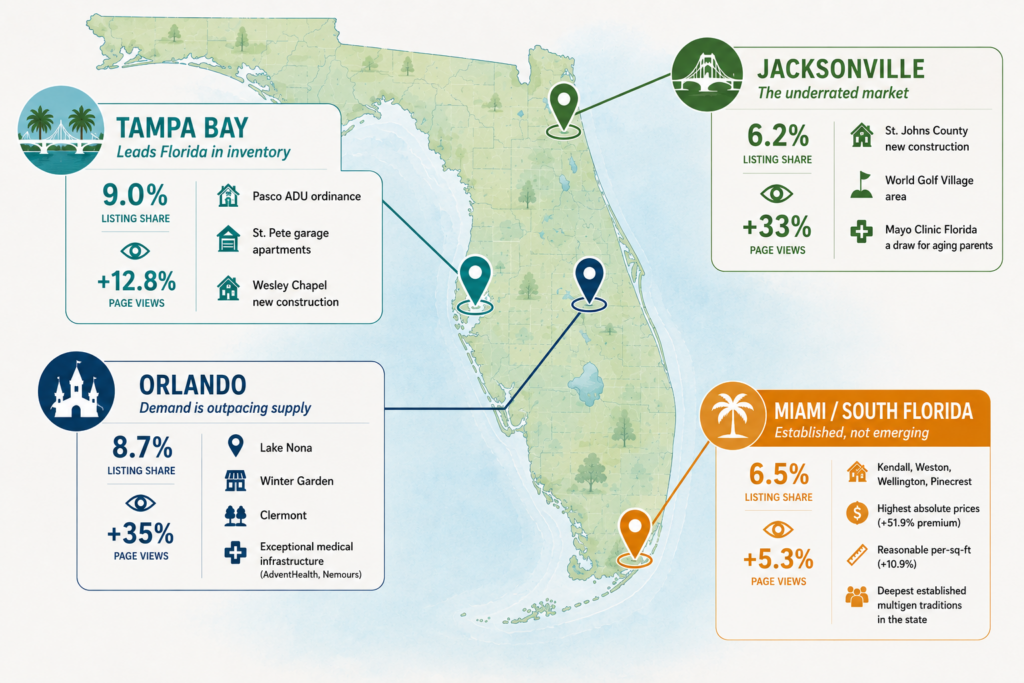
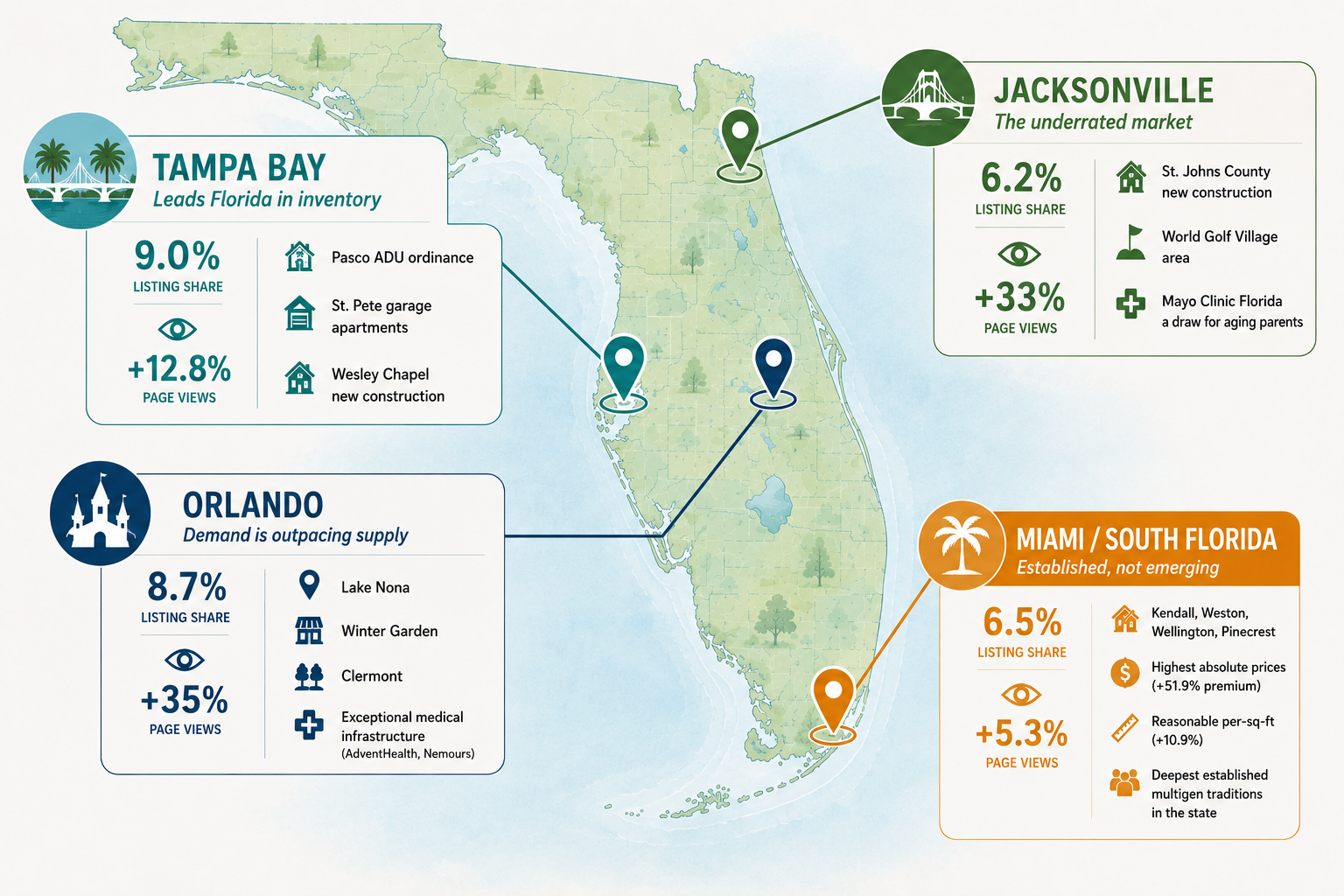
Here is the Realtor.com data for each metro at a glance. The national average for multigenerational listings is 6.1%.
+37.7% listing premium
+6.0% per sq ft
+37.3% listing premium
+2.1% per sq ft
+51.9% listing premium
+10.9% per sq ft
+42.3% listing premium
+11.6% per sq ft
At first glance these numbers look comparable. They are not. Each metro tells a different story when you look closely.
Tampa Bay: The high-supply, balanced market
What the data says. Tampa Bay has the highest multigen listing share in Florida (9.0%) — roughly one in eleven listings. Buyer interest is steady but not overheated (+12.8% page views, close to the national average). Per-square-foot premium is just +6.0%, meaning Tampa Bay buyers are paying for size, not scarcity.
What that means in practice. Tampa Bay is the market with the most genuine inventory and the least competitive pressure. Buyers do not face bidding wars on multigen homes the way they do in Orlando. Pasco County’s 2025 ADU ordinance opened new pathways for backyard secondary structures, and St. Pete’s older neighborhoods contain a stock of detached garage apartments that are uncommon elsewhere in Florida.
Where the inventory is. Wesley Chapel and Land O’ Lakes for new construction. Brandon, Riverview, Valrico, and Apollo Beach for mid-tier suburban suites. St. Pete’s Old Northeast and Snell Isle for the rare garage apartment configuration.
Best fit for: Buyers who want substantial inventory to choose from, reasonable per-square-foot pricing, and time to find the right home without bidding pressure. Strong choice for families who want balance between coastal access and suburban affordability.
Orlando: The high-demand, opportunity-rich market
What the data says. Orlando has strong supply (8.7% listing share, second only to Tampa) and exceptional demand (+35% page views — the highest in Florida and well above the national average of 13.5%). Per-square-foot premium is the lowest of any major Florida metro at just +2.1%, meaning Orlando buyers are paying almost entirely for size rather than configuration premium.
What that means in practice. Orlando is the most active multigenerational market in Florida. Strong builder activity across Orange, Osceola, Lake, Seminole, and Polk counties produces continuous new construction inventory. The high page-view premium means quality multigen homes move quickly — buyers benefit from being ready to act when the right property surfaces.
Where the inventory is. Orlando offers the widest range of options of any Florida metro. Lake Nona, Winter Garden, and Clermont lead in new construction. Wedgefield, Christmas, Apopka, St. Cloud, and Davenport corridors offer one-acre-plus parcels for custom acreage builds and ADU-friendly properties — a configuration nearly impossible to find in coastal markets at comparable prices. Polk County provides the most accessible entry points for buyers under $500K.
Best fit for: Buyers who want maximum optionality across new construction, custom builds, and acreage corridors at competitive prices. Strong choice for families relocating for the medical infrastructure (AdventHealth Orlando, Orlando Health, Nemours Children’s Hospital), hospitality industry careers, or proximity to inland Florida’s lower hurricane exposure.
Miami: The established, premium market
What the data says. Miami’s listing share (6.5%) and page-view premium (+5.3%) are both modest compared to Tampa or Orlando. But the listing price premium is the highest of the four metros at +51.9%, and the per-square-foot premium is meaningful at +10.9%. This is a mature market where multigenerational layouts have been part of the housing stock for decades, not a recent trend.
What that means in practice. South Florida has the deepest inventory of established multigenerational configurations in the state — courtyard casitas, detached guest houses, multi-wing layouts. Many were built specifically for extended family living going back to the 1970s and 1980s, often with cultural awareness baked into the design. The trade-off is that this is the most expensive Florida market and the homes are not always large in absolute terms.
Where the inventory is. Kendall, Weston, Wellington, Pinecrest, Coral Gables, and Bal Harbour for premium configurations. Older suburban neighborhoods in Miami-Dade and Broward for established casita stock. Palm Beach County for high-end estate configurations.
Best fit for: Families with cultural traditions of multigenerational living (Latino, Caribbean, South American), buyers wanting access to Miami’s international community and business infrastructure, and buyers who can afford the price premium for established lifestyle infrastructure. Less of a fit for buyers prioritizing acreage or maximum separation.
Jacksonville: The underrated value market
What the data says. Jacksonville’s listing share (6.2%) is just slightly above the national average — but the page-view premium of +33% is the second-highest in Florida, almost matching Orlando. Listing price premium is +42.3%, with per-square-foot premium of +11.6%. Translation: demand significantly outpaces supply, and the homes available command meaningful premiums.
What that means in practice. Jacksonville is the Florida metro most often overlooked by out-of-state buyers — and the data suggests that gap is creating opportunity. Overall housing costs are lower than other Florida metros, but multigenerational inventory is tighter, meaning the right homes get attention quickly. For buyers willing to act decisively, this can be the most cost-effective Florida multigen market.
Where the inventory is. St. Johns County’s new construction corridor offers the strongest multigen new construction. World Golf Village area for golf-community focused buyers. Nocatee for master-planned community options. Mayo Clinic Florida campus draws families specifically for healthcare proximity.
Best fit for: Cost-conscious buyers willing to act quickly when inventory surfaces, families relocating for Mayo Clinic Florida or Naval Air Station Jacksonville, and buyers wanting Atlantic coast access without South Florida pricing.
Which Florida metro fits your situation?
Beyond the data, the right metro depends on what your family actually needs. Here is an honest framework based on common buyer priorities.
If maximum inventory is your priority
Tampa Bay or Orlando. Both have substantially more multigen listings than Miami or Jacksonville, and both offer time to find the right home without bidding pressure.
Tampa Bay leans toward established inventory. Orlando leans toward new construction.
If maximum value is your priority
Jacksonville for outright lower pricing. Orlando’s Polk County corridor for the most accessible entry points in Central Florida. Tampa Bay’s eastern Hillsborough suburbs (Brandon, Riverview) for suburban value.
Skip Miami if budget is the leading factor.
If healthcare proximity matters most
Orlando (AdventHealth, Orlando Health, Nemours Children’s) and Jacksonville (Mayo Clinic Florida) both offer exceptional medical infrastructure. Tampa Bay (Tampa General, BayCare) is also strong.
Aging parent healthcare needs should weigh significantly in the metro decision.
If acreage and privacy matter most
Orlando’s acreage corridors (Wedgefield, Christmas, Apopka, St. Cloud, Davenport) lead. Jacksonville’s outer St. Johns County offers acreage at lower prices. Tampa Bay’s outer Pasco County provides growing options.
Miami is the wrong choice for buyers prioritizing acreage.
What the data does not tell you
Realtor.com’s data is useful but incomplete. A Florida metro decision involves factors that do not show up in listing statistics:
When we work with out-of-state buyers, narrowing the metro is often the first conversation — before any home tours begin.
Working with out-of-state buyers across all four metros
Most of our clients are not in Florida when they begin their search. They are calling us from New York, New Jersey, Ohio, Massachusetts, Illinois, California, and beyond. Choosing a Florida metro from a distance is one of the harder real estate decisions you can make, and we have built our practice around helping families do it well.
We do not push a specific metro. We work across all five Florida regions — including Southwest Florida and Sarasota / Bradenton, which the Realtor.com report did not cover. Our job is to help you find the right metro for your situation, not steer you toward where we have the most listings.
We coordinate virtual tours and pre-screening. Before any flight to Florida, we walk you through candidate properties remotely, drive through neighborhoods on video, and answer the questions that only show up when you actually visit a place.
We maximize your visits. When you do come to Florida, we organize the trip to make every day count. Pre-screened properties only, candidate communities grouped by region, and every question answered before you fly home.
We stay in the conversation as it evolves. Some clients narrow to one metro quickly. Others compare two or three over months. We do not push timelines. We do not pressure decisions. The right home in the right metro is a long-term decision, and we treat it that way.
Common questions
Frequently asked questions
Which Florida metro has the most multigenerational home inventory?
Which Florida metro is the best value for multigenerational buyers?
Which Florida metro is best for acreage and privacy?
Which Florida metro is best for healthcare access?
Considering a multigenerational move to Florida but not sure which metro fits your family? Let’s walk through your priorities and narrow it down.