

Family Compounds in Florida: Buying Acreage Properties for Multigenerational Living
Quick answer: A Florida family compound is an acreage property — usually one to five acres — with multiple separate residences that keep extended family close while preserving privacy and independence. Florida works well for this because agricultural-residential zoning across the state already allows multiple homes on a single parcel, HOA-light acreage corridors are common, and resale inventory spans from $400K–$500K rural parcels to multi-million-dollar Naples estates.
Family compounds are not just for the Kennedy family or ultra-wealthy estate buyers. Across Florida, middle and upper-middle market families are assembling acreage properties with multiple residences — and it is one of the most genuine multigenerational solutions available.
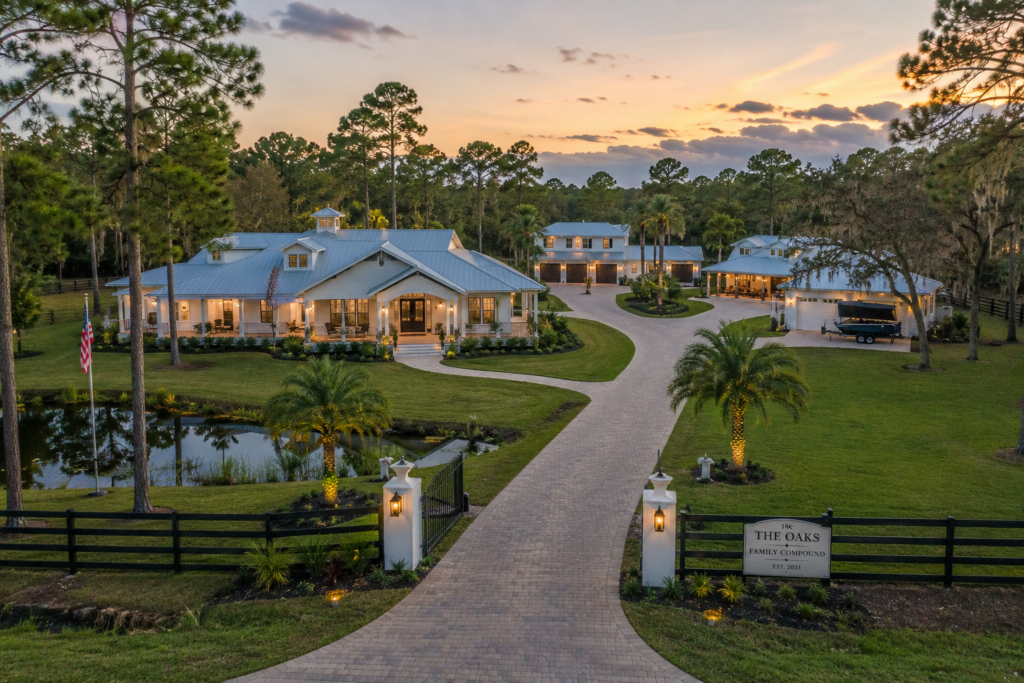
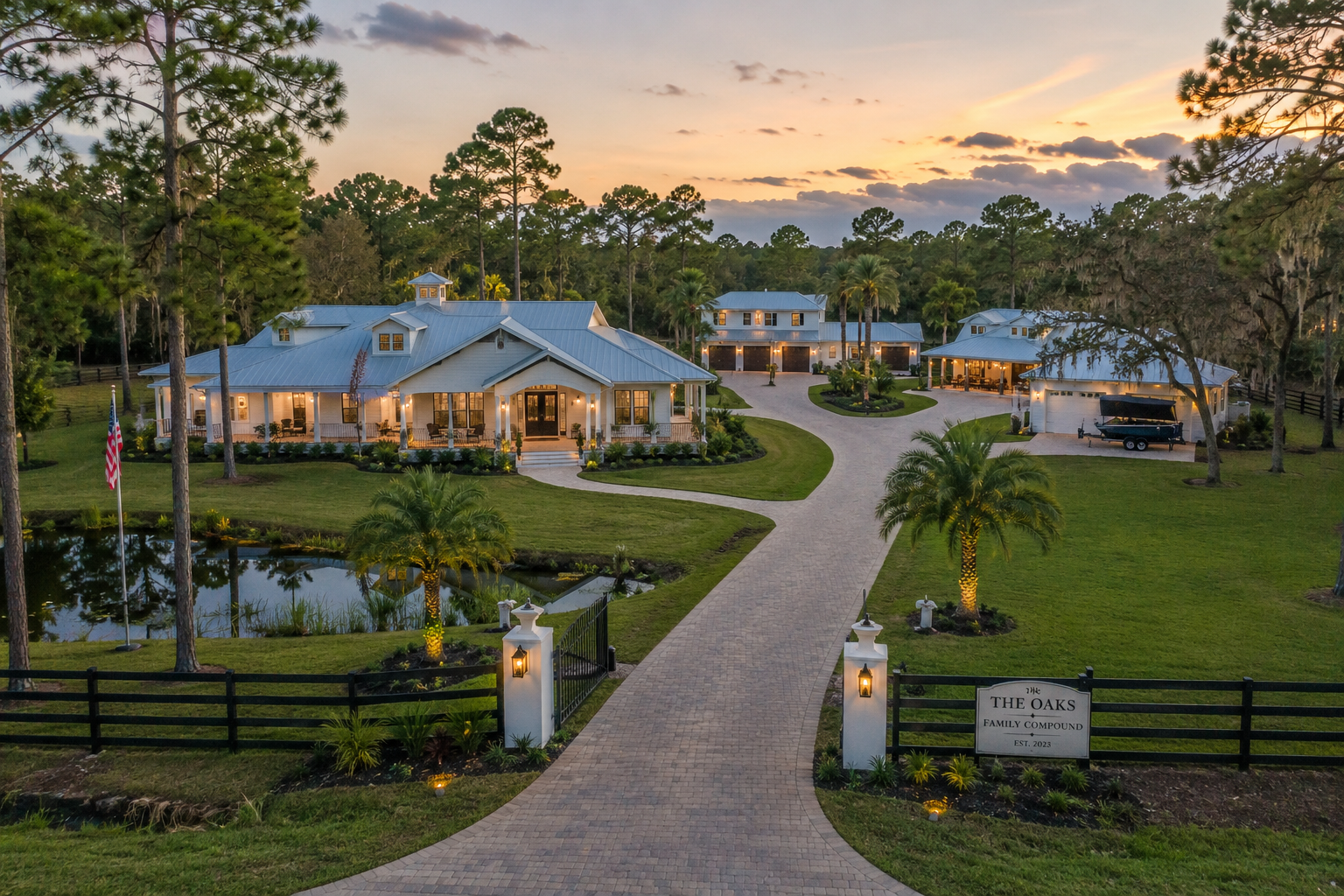
“Family compound” used to call to mind Hyannisport, or sprawling estates behind tall gates in Palm Beach. That image is changing. Across the country and especially in Florida, families with more modest budgets are assembling compound properties — usually one to five acres with multiple structures — to keep extended family close while preserving privacy and independence.
Reader’s Digest profiled the Pingree family in Boston, who turned a four-unit apartment building into a three-generation, ten-grandchild compound. Care economists have described the trend as a rational response to America’s broken care market. National data backs it up: the share of Americans living in multigenerational households more than doubled between 1971 and 2021, with about 60 million people in this living arrangement.
The momentum reaches all the way to the top of the market. As Forbes recently reported, a record 17% of homebuyers purchased a multigenerational home in 2024 — up from roughly 11% in prior years — and affluent families are increasingly assembling adjacent estates into private compounds as a deliberate, long-term strategy rather than a financial fallback.
Florida has emerged as one of the more practical states to do this — not because the state markets compounds, but because Florida happens to have what compound buyers actually need. Larger lots than most northern markets. Acreage zoning that allows multiple residential structures. Acreage zoning that already allows multiple residential structures on a single parcel. And inventory across price ranges from $500K rural parcels to multi-million-dollar Naples estates.
This is a guide to finding existing Florida acreage properties that can support a family compound — and the seven Florida markets where this inventory genuinely exists.
A family compound is not a single structure trying to do everything. It is multiple structures, deliberately separated, designed for togetherness without forced togetherness.
What a Florida family compound actually looks like
In practice, most Florida family compounds fall into one of three configurations. Each works for different family situations, and each has distinct considerations.
Main house + guest house
A primary residence with a separate, fully-equipped guest house on the same parcel. Both have full kitchens, bathrooms, and independent entrances. Often connected by a covered walkway, shared pool, or simply proximity.
Best for: aging parents, adult children, or extended family wanting genuine independence with proximity.
Main house + ADU + outbuilding
A primary home, a smaller secondary unit (ADU, casita, or converted barn), plus a larger outbuilding for storage, workshop, or future expansion. Common on rural acreage with agricultural-residential zoning.
Best for: multi-generation families with future expansion in mind. The outbuilding becomes Phase 2.
Adjacent parcels assembled
A family buys one home, then purchases the adjacent parcel when it becomes available. The two homes are operated as one compound while remaining legally separate properties — often easier for financing and resale flexibility.
Best for: families willing to assemble over time. Requires patience and willingness to act when neighbors sell.
ADU-capable acreage
A single-residence acreage property where zoning allows the future addition of an ADU or secondary structure. Florida’s 2025 statewide ADU law expanded which properties qualify.
Best for: families building a compound in phases. Buy the right property now, add the second structure later.
The common thread across all four configurations: separate buildings, deliberate distance, family proximity. The compound model rejects the “one big house” approach in favor of multiple independent spaces.
Why Florida acreage makes compounds achievable
Most states make this difficult. Restrictive zoning, small lot sizes, aggressive HOA covenants, and limited acreage inventory in desirable areas conspire against the compound model. Florida is structurally different in several ways:
Acreage zoning exists across the state. Most Florida counties have agricultural-residential zoning classifications (often called AG, A-1, A-2, RA, or similar) that allow multiple residential structures on a single parcel. This is meaningfully different from suburban single-family zoning, which typically restricts properties to one primary residence.
Florida’s ADU rules are a county-by-county patchwork. Florida’s ADU rules remain a county-by-county patchwork — there is no statewide mandate. Both the 2025 and 2026 attempts to require local governments to permit ADUs in single-family zones failed in the legislature. But many Florida counties, especially in agricultural-residential zones, already allow multiple residential structures on a single parcel, which is what makes the compound model achievable. Our full guide to the new Florida ADU law covers the details.
HOA-light and HOA-free areas exist. Most Florida acreage corridors have minimal or no HOA restrictions. This matters because HOA covenants are the single biggest obstacle to compound development — many HOAs restrict accessory structures, additional residences, or rental of secondary units. Acreage zoning typically operates outside HOA jurisdiction.
Mature compound inventory already exists on the resale market. Florida has decades of properties built with multiple structures — original homesteads where families added guest houses, equestrian properties with grooms’ quarters, ranch operations where the foreman’s house became extended family housing. Many of these properties are now coming to market as the original owners age out.
Agricultural classification can reduce property taxes. Properties of certain sizes engaged in qualifying agricultural use (cattle, hay, row crops, beekeeping) may qualify for agricultural tax classification, substantially reducing the tax burden of holding acreage. Rules vary by county and use must be genuine — this is a meaningful consideration to discuss with a property accountant before buying.
The seven Florida markets where compound acreage exists
Compound-capable acreage exists across Florida but concentrates in specific corridors. These are the seven markets where resale inventory is meaningful enough to focus a search.
Alva
Lot sizes: Commonly 2-10+ acres. Some properties exceed 20 acres.
Typical pricing: $500K-$1.5M depending on acreage and existing structures.
What you find: Old Florida homesteads, equestrian properties, ranch-style configurations with main house, guest cottage, and outbuildings. River access along the Caloosahatchee for some properties.
North Fort Myers
Lot sizes: Mixed — pockets of 1-5 acre properties in the Bayshore and Slater Road corridors.
Typical pricing: $400K-$900K for acreage with existing improvements.
What you find: More affordable entry point into Southwest Florida acreage. Properties often include main house plus mother-in-law cottage or workshop with apartment.
Wedgefield
Lot sizes: 1-acre minimum, with many properties in the 2-5 acre range.
Typical pricing: $600K-$1.5M for compound-capable properties.
What you find: Equestrian-focused community east of Orlando. Properties commonly include barns, paddocks, and second residences for grooms or family. Excellent for families with horses or wanting that lifestyle option.
Apopka
Lot sizes: Wide range — from 1-acre estate properties to 10+ acre rural parcels in the northwest corridor.
Typical pricing: $550K-$1.3M depending on acreage and configuration.
What you find: Mix of established estate properties and rural compounds with multiple structures. Northwest Orange County corridor especially strong for ADU-friendly acreage.
Oviedo
Lot sizes: Pockets of 1-3 acre estate properties in older sections, particularly off Lockwood and Mitchell Hammock corridors.
Typical pricing: $700K-$1.6M for established compound-capable properties.
What you find: Established estate homes with separate guest cottages or in-law suites, often with significant landscaping and mature oak canopies. Good school districts make this strong for families with grandchildren in the household.
Myakka City
Lot sizes: 5-20+ acres. True rural Florida.
Typical pricing: $600K-$2M depending on acreage and structures.
What you find: Working ranches, equestrian properties, true Old Florida homesteads. Often include multiple barns convertible to living quarters, original main houses, and substantial outbuildings. East of Lakewood Ranch but a world apart culturally.
Naples
Lot sizes: Estate parcels of 1-5+ acres in Golden Gate Estates, North Naples, and eastern Collier County.
Typical pricing: $1.5M-$8M+ depending on location, acreage, and existing structures.
What you find: The premium end of Florida compound inventory. Estate properties with main residences, detached guest houses, pool houses converted to living quarters, and architecturally significant outbuildings. Some of the best mature compound resales in Florida exist here.
These seven markets cover the practical Florida compound landscape from $400K entry points to $8M estate properties. Other Florida acreage corridors exist — Lake Mary, St. Cloud, Brooksville, and others — but the seven above represent where compound-specific inventory consistently surfaces on the resale market.
What to verify before buying compound-capable acreage
Acreage properties with multiple structures require deeper due diligence than typical residential purchases. Critical items to verify before making an offer:
A specialist real estate agent verifies these factors during the offer process — before commitment, not after.
The tradeoffs of compound living that families should know
Family compounds are not the right answer for every family. Several real tradeoffs deserve honest acknowledgment.
Acreage means commute distance. Most Florida acreage corridors are 20-45 minutes from major employment centers, shopping, and healthcare facilities. For active working families this matters. Alva is 30 minutes from Fort Myers. Wedgefield is 30 minutes from downtown Orlando. Myakka City is 45 minutes from Sarasota. Daily driving adds up.
Maintenance is genuinely more work. Acreage requires mowing, fencing, well and septic system maintenance, pest control, brush management, and ongoing care that suburban lots simply don’t. Multiple structures mean multiple roofs, multiple HVAC systems, multiple kitchens to maintain. Some families thrive on this lifestyle. Others discover after a year that they hate it.
Insurance is more complex and often more expensive. Multiple structures, outbuildings, and rural locations all affect insurance pricing and complexity. Some Florida acreage corridors have limited carrier options, especially after recent insurance market disruptions.
Resale market is smaller and more specific. Compound properties have a smaller buyer pool than typical residential homes. When you decide to sell, finding the right buyer can take longer. This is not a problem for families planning to stay 10+ years, but it matters for shorter holding periods.
Family dynamics still matter — maybe more. The Reader’s Digest profile of the Pingree family is candid about this — multigenerational compounds work best when family relationships are already healthy. Compounds amplify family dynamics rather than transform them. Families with unresolved conflict often discover that proximity makes things harder, not easier.
Not every Florida region works. Compounds require acreage, and acreage requires distance from population centers. Families wanting urban or beachfront proximity will struggle to find compound-capable properties. South Florida coastal markets, downtown St. Pete, and Sarasota’s barrier islands don’t really have this inventory.
Compound property searches require a specialist approach
Compound-capable acreage rarely shows up in standard MLS searches with the right filters. Listings get tagged inconsistently. Many of the best properties are described as “estate property” or “ranch” or “equestrian” rather than “family compound” or “multigenerational.” Generic search filters miss most of them.
We know where to look across all five Florida regions. We work across Southwest Florida (Alva, North Fort Myers, Naples), Central Florida (Wedgefield, Apopka, Oviedo), and the broader Florida acreage corridors. The same buyer often considers properties in multiple regions, and we help compare them fairly.
We coordinate the due diligence specific to compound properties. Zoning verification, structure permit status, septic and well capacity assessment, easement review, insurance feasibility — these are routine for us, not exceptional.
We watch for adjacent parcel opportunities. For families pursuing the “main house first, adjacent parcel later” strategy, we monitor neighboring properties for early signals that they may come to market.
Family compounds aren’t a casual real estate transaction. They are a long-term family decision. We treat them that way.
Common questions
Frequently asked questions
What is a family compound?
Where in Florida can you find family compound acreage?
Does Florida zoning allow more than one home on a property?
What should I verify before buying compound acreage in Florida?
Exploring a Florida family compound for your extended family? Let’s talk through which markets and configurations actually fit your situation.