

The Millennial Suite: Why Florida Families Are Adding ADUs for Their Adult Children
Quick answer: A “millennial suite” is an accessory dwelling unit (ADU) added to the family property so an adult child can live with real independence — a full kitchen, separate entrance, private bath, and living space, typically 400 to 800 square feet. Florida families build them as a practical response to home prices outpacing wages, usually either by adding an ADU to property they already own or by buying a home with the zoning and lot size to add one later. Construction generally runs $80,000 to $200,000-plus.
Adult children living on the family property isn’t a step backward anymore. For a growing number of Florida families, it’s a practical response to housing prices, an opportunity to build generational wealth, and an unexpectedly good way to stay close to family without sacrificing independence.
A couple in their early sixties called us recently. They were looking for a home around $600,000 — a three-bedroom, two-bath place where they could live comfortably and their married daughter and son-in-law could live in a separate suite with its own kitchen and private entrance. The kids couldn’t afford their own home on the open market. The parents wanted them close, but with privacy.
The configuration they wanted exists across Florida at their price point in plenty of markets — but they had their hearts set on Sarasota, and Sarasota’s higher-priced market made that exact combination hard to find at $600,000. In Sarasota specifically, homes with two full kitchens and true separate entrances tend to price closer to $900,000.
What did exist for them at $600,000: solid three-bedroom homes in their preferred area with good zoning, the right lot size, and the potential to add an ADU later. The path to what they actually wanted wasn’t buying finished. It was buying with a plan.
This conversation is happening across Florida right now. Adult children in their twenties and thirties are facing a housing market unlike anything their parents encountered at the same age. A 2023 RentCafe study found that 20% of Millennials and 68% of Gen Z adults currently live in multigenerational households, totaling roughly 37 million young adults sharing a home with at least one family member nationwide. Many don’t see things changing soon — over 40% of Millennials and Gen Z respondents in the same study said they expected to keep sharing a home for at least another two years.
For families with land and the means to help, an ADU on the family property has emerged as one of the most practical responses to this reality. Some builders are calling these spaces “millennial suites.” Others use older terms like “in-law suite,” “casita,” or “garden cottage.” The naming varies; the configuration is similar.
This isn’t about adult children failing to launch. It’s about families recognizing that the affordability math has changed — and that pooling resources across generations is often more practical than each generation struggling alone.
Why the math has changed for young adults
A few realities worth acknowledging plainly. None of these are anyone’s fault — they’re just the current environment for young adults trying to make their way in Florida.
Florida home prices have risen faster than wages. Median home prices across Florida have climbed substantially since 2020, while wage growth for entry-level and mid-career workers has not kept pace. The gap between what a young adult earns and what a starter home costs is meaningfully larger than it was for the previous generation at the same age.
Rents have risen alongside home prices. Renting to save for a down payment used to be the conventional path. In current Florida rental markets, market-rate rent often consumes 35-50% of a young adult’s take-home pay, leaving little room to save for the larger down payments required at current home prices.
Insurance and HOA costs have grown. Florida’s homeowners insurance market has tightened significantly. HOA fees in many communities have climbed faster than inflation. These are fixed costs of homeownership that weren’t as dominant in family budgets a generation ago.
Student loan obligations are real for many. A meaningful share of young adults under 35 carry student loan balances that affect their debt-to-income ratios when applying for mortgages, even when their income would otherwise qualify them.
Childcare costs delay home buying for new families. Young couples having children face Florida childcare costs that rival or exceed their housing costs. This further delays when they can save for a home of their own.
None of this is a moral failing. It’s just a different environment than the one their parents bought homes in. And families are responding by finding creative ways to help — and an ADU on the family property is one of the most practical responses available.
What a millennial suite actually looks like
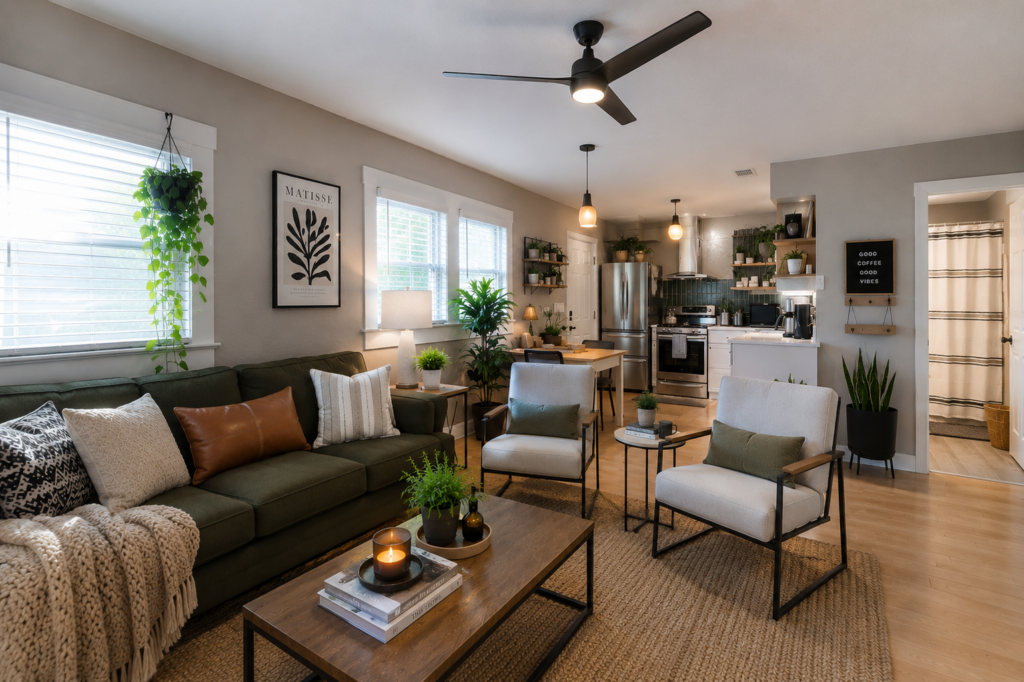
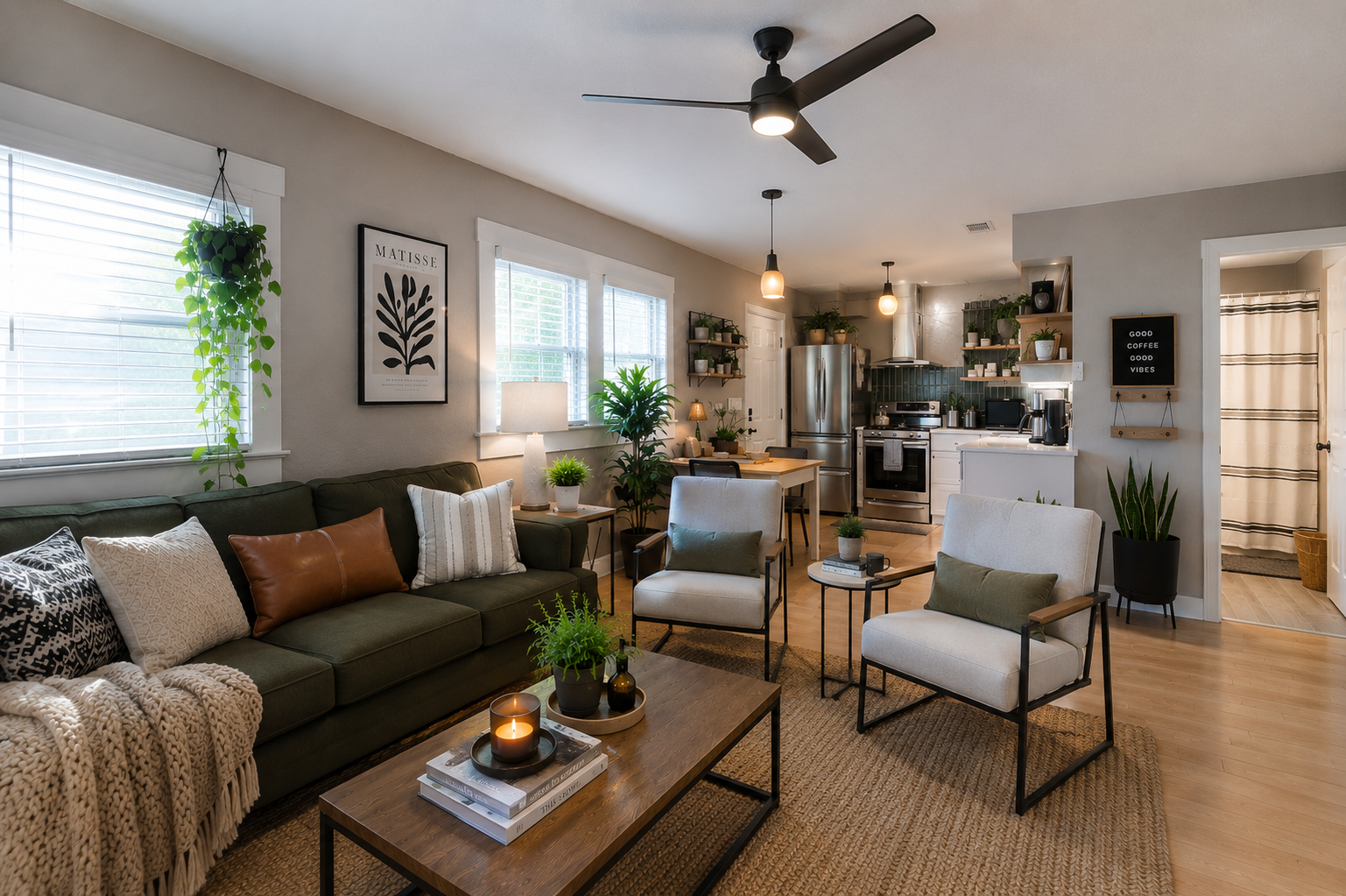
The name varies — millennial suite, adult child ADU, garden cottage, accessory dwelling unit, casita. The configuration is similar: a small but complete dwelling on a family property, providing the adult child (or couple, or young family) with real independence while staying physically close to parents.
The features that make it work:
Full kitchen. Not a kitchenette. Real cooking, real meals, real grocery shopping. This is the dignity-preserving feature that separates “their own home” from “a guest room with a microwave.”
Separate entrance. The adult child should be able to come and go without walking through their parents’ home. Critical for couples, for anyone working unconventional hours, and for anyone bringing a partner home.
Private bathroom. Full bath, not shared. Privacy basics.
Living space beyond the bedroom. A small living area or sitting space — somewhere to read, watch TV, host a friend, have a video call — without having to be on the bed.
Outdoor connection. A small patio, porch, or yard space that feels separate from the main house. This matters more than most families anticipate.
Total size is typically 400-800 square feet. Construction cost in Florida ranges from $80,000 for a basic detached ADU to $200,000+ for a higher-finish or larger configuration. Some families build smaller, simpler, and add detail over time. The key is functionality first.
Two ways Florida families are doing this
Most Florida families pursuing this configuration end up on one of two paths, depending on whether they already own property or are starting from scratch.
Path 1: Add an ADU to existing family property
Parents already own a home with land, appropriate zoning, and the lot size to accommodate a secondary structure. They add an ADU to the existing property, providing the adult child with their own space without buying a new home.
Path 2: Buy a property with the right potential
Parents buy a Florida home that has the zoning, lot size, and configuration to support an ADU addition, then build the ADU within the next 1-3 years as funds and family timing allow. The home today becomes a multigenerational property tomorrow.
A third path exists too: buying a Florida home that already has an existing ADU in place. This is the most expensive option but skips the construction process entirely. For families on a tighter timeline, it can be worth the premium. For our perspective on this option, see our guide on what to look for when buying a Florida home with an existing ADU.
Questions every family should answer first
This isn’t a casual decision. The families who do this well tend to talk through several questions before committing to a configuration. The families who struggle often skipped these conversations.
How long is this arrangement for? A two-year stretch while the adult child saves for a down payment is a different conversation than a long-term, possibly permanent arrangement. The configuration that fits a short bridge isn’t always the same as the configuration that supports decades of independent living. Be honest about the timeline expected.
Who pays for what? Some families have the parents pay for the ADU construction outright and the adult child contribute rent or utilities. Others structure it as a co-investment with documented agreements. Others have the adult child pay parents back over time. There’s no single right answer, but families who avoid this conversation tend to discover hard feelings months later.
What happens to the ADU long-term? Does the adult child eventually move out, freeing the ADU for rental income, guests, or aging-in-place for the parents? Does the property eventually pass to the adult child through estate planning? Different answers lead to different decisions today.
How does this affect estate plans and other siblings? If there are other adult children who aren’t living on the property, how does the family handle the perceived imbalance? Many families handle this through carefully structured wills, life insurance, or other planning. Worth thinking about before, not after.
Are everyone’s expectations realistic about privacy and family contact? Adult children moving back to family property often imagine more independence than they end up having. Parents often imagine more daily contact than the adult child wants. Talk about this directly — what daily interaction actually looks like for everyone.
Why Florida makes this newly possible
Florida has emerged as one of the most ADU-friendly states in the country, and the recent legislation has accelerated this. A few specifics worth knowing:
Acreage zoning corridors exist statewide. Most Florida counties have agricultural-residential zoning classifications that allow multiple residential structures on a single parcel. This is meaningfully different from suburban single-family zoning that restricts properties to one primary residence.
HOA-light and HOA-free areas are available. Many Florida acreage corridors and older neighborhoods operate outside HOA jurisdiction, removing one of the biggest obstacles to ADU construction. Restrictive HOAs are the single biggest reason ADU plans fail elsewhere.
Construction costs are manageable. Florida ADU construction generally runs less than equivalent construction in higher-cost states. The combination of mature builder networks, mild climate (no basements, no heavy insulation packages), and competitive material supply keeps costs predictable.
The resale market exists. If a family’s situation changes and the property eventually needs to be sold, Florida has a real buyer pool for ADU-equipped homes. The improvement doesn’t lock the family in — it adds optionality.
What this typically costs in Florida
A rough sense of the math, because it matters for planning:
Detached ADU construction: $80,000 to $200,000 depending on size, finishes, and site preparation. Smaller, simpler units at the low end. Higher-finish or larger units at the upper end.
Garage conversion ADU: $40,000 to $90,000 if the existing garage structure is sound and the systems (electrical, plumbing) can be extended. Significantly more if structural work is needed. Not all municipalities allow garage conversions, it’s important to verify if it’s something you want to pursue.
Prefab/modular ADU: $60,000 to $150,000 for the unit, plus site preparation, utilities, and permits. The total installed cost is often higher than the manufacturer’s quoted unit price suggests.
Permit and design fees: $3,000 to $10,000 depending on the county and the complexity of the project.
Property tax impact: Adding an ADU typically increases the property’s assessed value, which may increase annual property taxes. The increase varies by county. Our blog post on how much ADUs add to home value in Florida covers the tax considerations in detail.
Where we fit into this decision
Most real estate agents close transactions on homes. We help families plan multigenerational futures. The difference matters when the goal isn’t just buying the right house today, but buying a house that supports what the family wants three or five years from now.
For families looking to buy a Florida property with ADU potential: We focus the search on properties with the right zoning, the right lot configuration, and the right HOA situation to support an ADU addition later. Not every “great” property is great for ADU expansion. We know what to verify.
For families with an existing Florida property considering an ADU addition: We help confirm whether the property and HOA allow it, and connect you with Florida ADU builders and zoning specialists we trust. We are not contractors and don’t build ADUs ourselves, but we work alongside families through the planning process.
For families wanting to buy a Florida home with an ADU already in place: We maintain a current list of resale homes with secondary living quarters across the state. It’s a starting point for families who want to skip the construction process entirely.
See current Florida ADU resale homes →
Free access. Refreshed weekly.
The shift in how families think about housing
For a generation of Americans, the assumption was that every adult eventually moved into their own separate home. Children left, parents stayed, and the family kept in touch through visits and holidays. That model worked when entry-level homes were affordable and young adults could realistically buy their own within a few years of starting their careers.
That model still works for some families. For others, it no longer matches the math. A growing number of Florida families are choosing a different configuration — one that mirrors how families lived for most of human history, with multiple generations sharing land and supporting each other’s stages of life.
A millennial suite on the family property isn’t a regression. It’s an adaptation. And done thoughtfully, it can deliver something modern American housing has often failed to provide: real proximity to family, real independence for everyone, and real financial breathing room for the generation behind us.
If this configuration fits how your family wants to live, we’d love to help you find or plan the property that supports it.
Common questions
Frequently asked questions
What is a millennial suite?
What features does an ADU for an adult child need?
How much does it cost to build a millennial suite ADU in Florida?
How do Florida families typically add an ADU for an adult child?
Thinking about a multigenerational setup for your adult child or your parents? Let’s talk through what’s actually possible in Florida.