

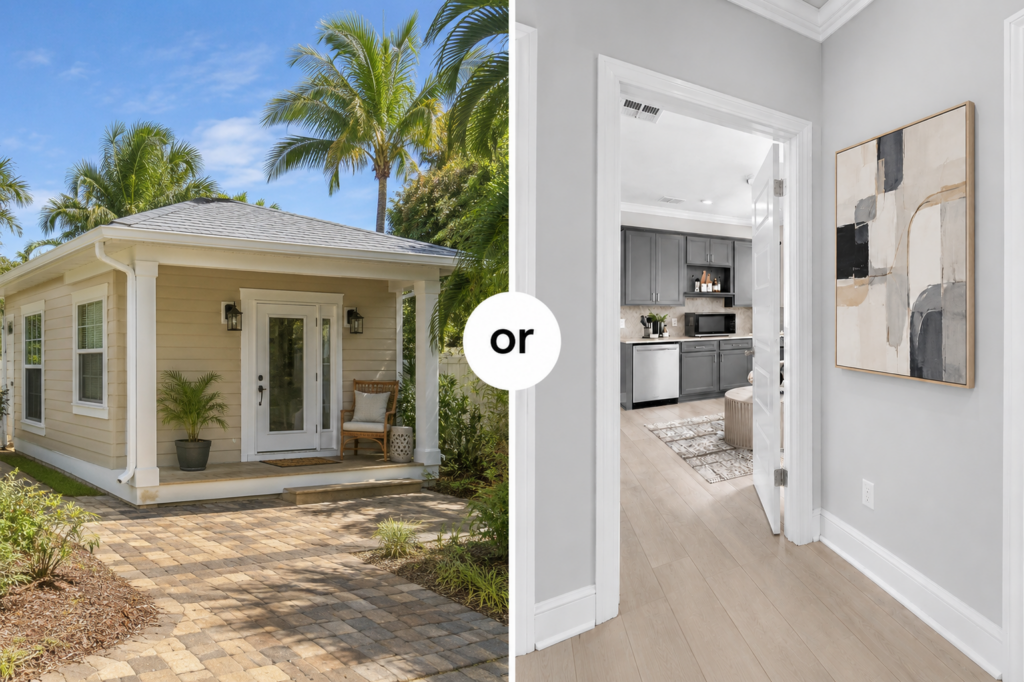
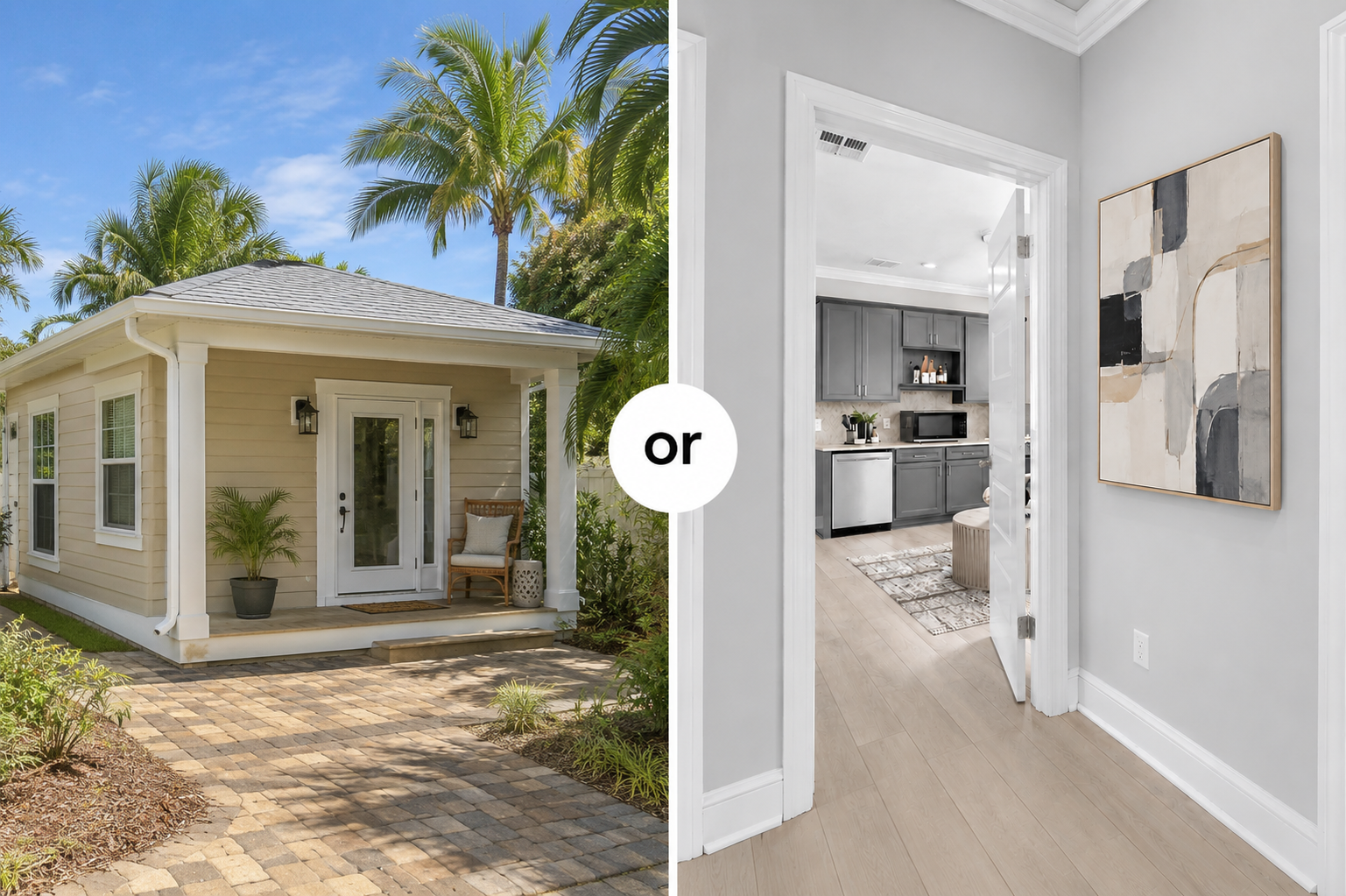
Guest House vs. In-Law Suite: Mobility, Privacy & Independence
Quick answer: The core difference is independence. A Guest House is a separate dwelling with its own full kitchen, bathroom, and entrance, permitted by the county as a secondary residence. An in-law suite is a private space within the main house — bedroom, bath, sometimes a kitchenette — that shares the home. Guest homes cost more (often a 10–25% premium in Florida) but add more value and can be rented; in-law suites are warmer, cheaper, and easier to resell to a wider buyer pool.
They sound similar, get used interchangeably in listings, and can cost very different amounts. Here’s the practical difference, the configurations that actually exist, and how to know which one fits your family.
If you’re shopping for a Florida home that can house extended family — aging parents, an adult child, a long-term guest, or a future tenant — you’ve probably noticed the terminology is confusing. The same listing might be described as having an “in-law suite” in one ad, an “ADU” in another, a “casita” in a third, and a “guest house” in a fourth. Different real estate agents use the words differently. So do builders, appraisers, and county building departments.
The confusion matters because these terms can describe very different things. A home with a true ADU is functionally different from a home with an in-law suite — different in price, different in flexibility, different in how it can be used, and different in how lenders, appraisers, and insurance carriers treat it.
This is a practical guide to the difference between the two, the configurations you’ll actually see in Florida resale inventory, and the questions to ask yourself before deciding which one is right for your family.
Neither configuration is universally better. They fit different families, different budgets, and different living situations. The right question isn’t “which one is best” — it’s “which one fits what we actually need.”
What is an ADU?
An ADU — short for accessory dwelling unit — is a secondary dwelling on the same property as a primary home, functioning as its own independent residence. The defining features:
Separate from the main house. Either detached (a freestanding cottage, casita, or guest house) or attached but functionally independent (a basement apartment, garage conversion, or above-garage suite with its own entrance).
Has its own full kitchen. A real kitchen with full-size appliances, not a kitchenette. This is the single most important defining feature.
Has its own bathroom. Full bathroom, not a half-bath.
Has its own entrance. Someone can come and go without walking through the main house.
Recognized as a separate dwelling unit by the county. The structure is permitted as a habitable accessory dwelling, not as a shed or office or storage.
In short, an ADU functions like a small home that happens to share a property with the main residence. Two households can live entirely separate lives under the same address.
What is an in-law suite?
An in-law suite is a defined private space within the main house, designed to give a family member or long-term guest their own area while still sharing the larger home. The defining features:
Part of the main house. Not detached or independent. The suite is a section of the home set apart from the primary living areas.
Typically includes bedroom, bathroom, and living area. A private space with the basics for daily living comfort.
May have a kitchenette, may not. This is where in-law suites vary the most. Some have a small kitchenette (microwave, mini-fridge, possibly a small sink). Some have nothing — meals happen in the main kitchen.
Usually accessible from inside the main house. May or may not have a separate exterior entrance. When it does, it’s still part of the same building.
Not a separate dwelling unit. The county sees it as part of the primary residence, not a secondary home.
An in-law suite gives a family member their own space and privacy, but the household is still functionally one home with shared spaces. The arrangement assumes meaningful togetherness — shared kitchen, shared common areas, shared front door for most daily comings and goings.
ADU vs. in-law suite at a glance
Why listings get the terminology wrong
If you’ve been searching Florida real estate listings, you’ve already noticed that the terms get used loosely. A property described as having an “in-law suite with kitchen” might actually have a full ADU. A property described as having an “ADU” might actually be a bonus room with a microwave and mini-fridge. The labels aren’t standardized.
Part of this is honest marketing. The term “ADU” sounds more modern and valuable, so some sellers use it even when the structure doesn’t quite meet the technical definition. The term “in-law suite” sounds warmer and family-friendly, so some sellers use it for spaces that are technically full ADUs.
Part of it is genuine ambiguity. The line between a large in-law suite with its own kitchen and an attached ADU is genuinely blurry. Whether it’s one or the other can depend on county zoning classification, how the original permits were pulled, and even how the appraiser categorizes it.
The practical implication: don’t rely on listing terminology to tell you what you’re actually buying. Look at the specific features — kitchen, entrance, permits, separation — and let those determine which configuration the property actually has.
Which configuration fits your situation
Neither one is universally better. The right choice depends on who’s living in the secondary space, how much independence everyone wants, and how the arrangement might evolve over time.
An ADU is often the better fit when:
· The family member wants real independence — own kitchen, own entrance, own routine
· You may want rental income from the unit at some point
· The arrangement is long-term and you want to preserve everyone’s autonomy
· You’re caring for an adult child or aging parent who values privacy
An in-law suite is often the better fit when:
· The family member needs proximity for safety or care, not full independence
· Shared meals and shared common space are part of the appeal
· The arrangement may evolve — the suite becomes a guest room, office, or media room later
· You want a smaller price premium and easier resale to a wider buyer pool
In practice, many families discover their preference during property tours, not before. Walking through an ADU and feeling how separated it really is — versus walking through an in-law suite and feeling how connected the suite is to the main house — clarifies the choice in ways that a checklist can’t.
What each configuration typically costs
Homes with full ADUs typically cost more than homes with in-law suites — sometimes significantly more. The premium reflects several real differences:
More usable space. A detached ADU adds genuine independent living space, often 500-1,200 square feet of fully equipped dwelling. An in-law suite is typically smaller and shares common areas with the main house.
More flexibility for the buyer. An ADU can serve as a rental, a multigenerational home, a guest house, a home office with privacy, or future-evolved use. An in-law suite has fewer variations.
Higher appraised value. Permitted ADUs typically add more appraised value than in-law suites — sometimes substantially more, depending on the property and neighborhood. Our blog post on how much ADUs add to Florida home value covers the appraisal framework in detail.
In Florida specifically, expect to pay a 10-25% premium for a home with a properly permitted ADU compared to a similar home with just an in-law suite. The premium varies by region, configuration, and how mature the local ADU market is.
If you decide on an ADU, should you buy one or build one?
Once a family decides an ADU is the right fit, the next question is whether to buy a home that already has one or to buy a home and build one.
Buying a home with an existing ADU works well when timeline matters, you’d rather walk through the finished space before committing, or you simply want to skip the construction process. The unit is already built and recognized.
Buying a home and building an ADU works well when you want full control over layout, finishes, and configuration, and you have the time and budget for a 6-18 month construction process.
Looking at Florida homes with existing ADUs?
If you’ve decided an ADU is the right fit and you’d like to see current Florida resale inventory, we maintain a list of homes with secondary living quarters, full kitchens, and pricing under $1 million across the regions we serve.
See the current Florida ADU resale list →
Updated weekly. Free access. No pressure.
We help families figure out which configuration fits
Every family situation is different. The configuration that works beautifully for one family might be exactly wrong for another. That’s why we don’t push a single answer — we help families think through the variables that actually matter for their specific situation.
For families exploring ADU homes: We help you understand what to verify when you find a property, including permit status, HOA rules, and how the ADU configuration affects your loan and insurance.
For families exploring in-law suite homes: We help you evaluate whether the suite truly delivers the privacy and independence your family needs, and how the configuration might evolve over time.
For families still deciding: We can walk you through both configurations on real Florida properties, so you can feel the difference rather than just imagine it.
The best configuration is the one that actually fits how your family wants to live — not the one with the trendier name.
Common questions
Frequently asked questions
What is the main difference between an ADU and an in-law suite?
Does an ADU or an in-law suite add more value to a Florida home?
Can you rent out an in-law suite like an ADU?
Why do Florida listings use ADU and in-law suite so inconsistently?
Trying to figure out which configuration fits your family? Let’s talk it through.